All lessons Module 2: Organs Lesson 10
The Triple Burner: four views
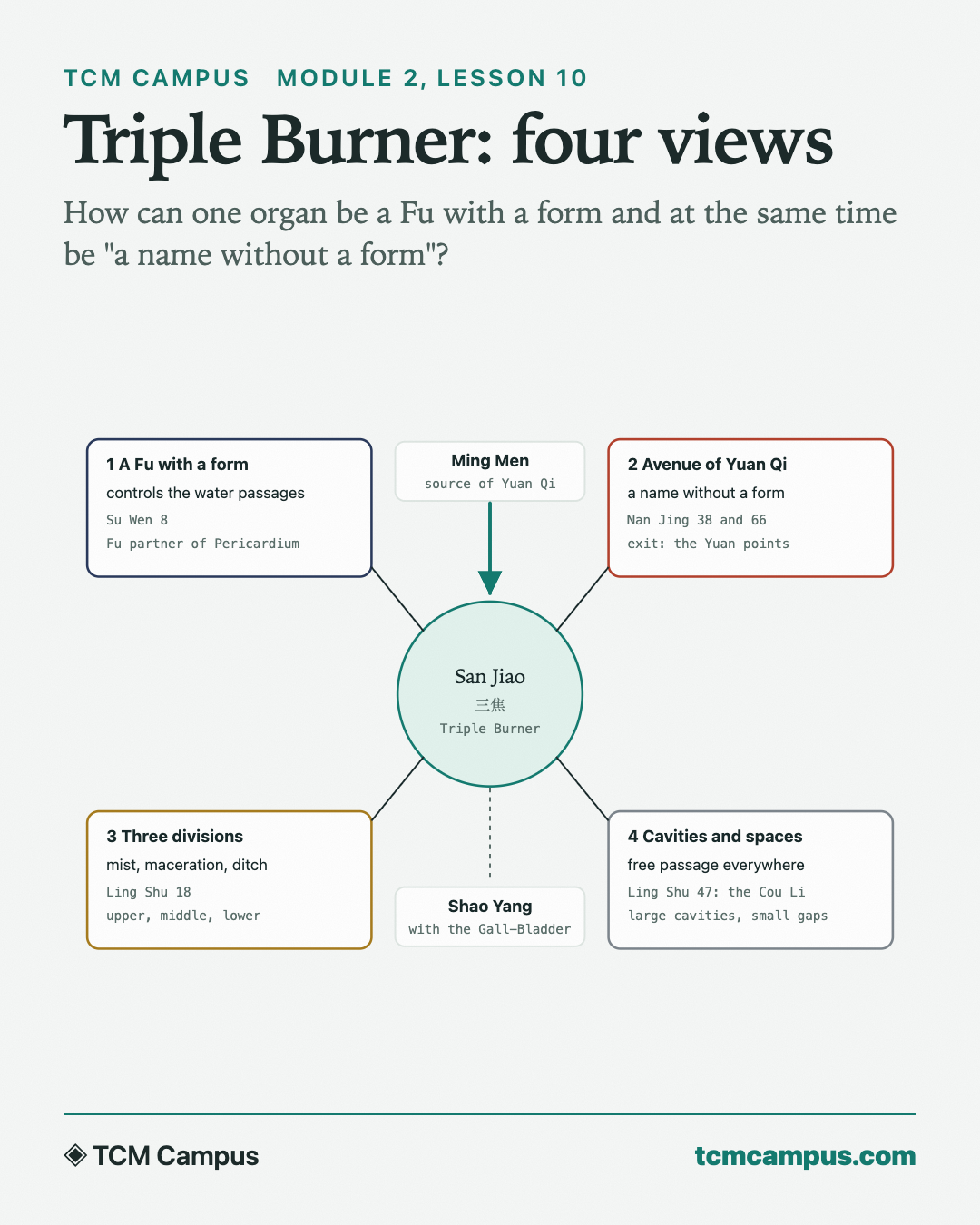
How can one organ be a Fu with a form and at the same time be "a name without a form"?
After this lesson you can name the four views of the Triple Burner (San Jiao) with their classical source, their task and their picture when they falter; you can hear which view a practitioner means. Module 1, lesson 5 gave the mist, the cauldron and the drain; this lesson adds the map around them.
Know by heart
- Four views. A Fu with a form (water passages); the avenue of the Yuan Qi (a name without a form); three divisions of the body; a system of cavities and spaces. mnemonic: a pipe, a messenger, three floors, the space in between.
- Three classical sentences. Su Wen 8: the official who opens up the water passages. Nan Jing: a name without a form, the envoy of the Yuan Qi, which emerges at the Yuan points. Ling Shu 18: above a mist, in the middle a maceration chamber, below a drainage ditch.
- What each division does. The upper spreads (Heart, Lungs, Pericardium); the middle transforms (Stomach, Spleen); the lower separates and excretes (Kidneys, Bladder, intestines, Uterus). mnemonic: breathe out, cook, drain away.
- Partner and channel. Fu partner of the Pericardium; channel: hand Shao Yang, together with the Gall-Bladder the pivot between outside and inside.
- The engine. Yuan Qi from Ming Men drives Qi transformation in each division via the San Jiao (ch. 4 p. 87).
- When it falters. Fluid that cannot get away, by level: upper, face and eyelids; middle, heaviness and sticky stools (pattern 8); lower, ankles and urine (pattern 12); if the engine is missing, all three falter.
The rest of this lesson is reference.
Three practice questions from this lesson
Which view says that the San Jiao 'has a name but no form'?
- A Fu with a form
- Three divisions of the body
- The avenue of the Yuan Qi
Answer: The avenue of the Yuan Qi. The Nan Jing (chapter 38, paraphrase): a name without a form, the envoy of the Yuan Qi. In view 1 it does have a form.
The Su Wen (chapter 8) calls the San Jiao the official of...
- making the decisions
- storing and distributing the grain
- opening up the water passages
Answer: opening up the water passages. Su Wen 8: the water passages come from it (paraphrase). Decisions belong to the Gall-Bladder, storing and distributing the grain to the Stomach and Spleen.
Ling Shu 18: the middle division is like...
- a maceration chamber
- a drainage ditch
- a mist
Answer: a maceration chamber. Upper a mist, middle a maceration chamber, lower a drainage ditch. The character 沤 means to soak or to ferment; other translations say bubbling cauldron or swamp.
The rest of this lesson
In the course you get the step-by-step explanation, 13 case-based practice questions, 13 spaced-repetition flashcards, the pitfalls and the bridge to physiology with evidence grades. This lesson belongs to module 2: Organs.