All lessons Module 7: Treatment Lesson 7
Treatment plans: Stomach, Intestines, Gall-Bladder and Bladder
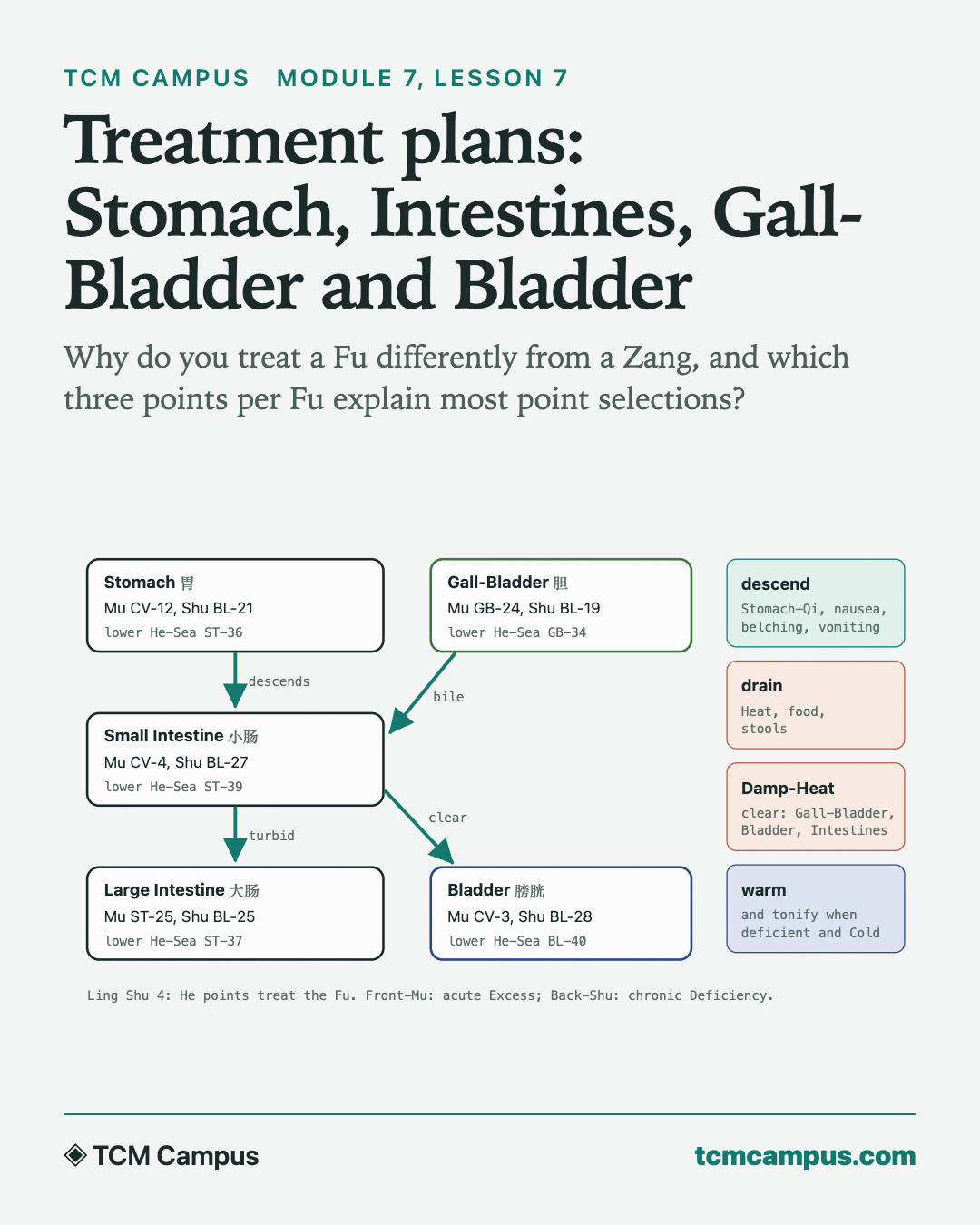
Why do you treat a Fu differently from a Zang, and which three points per Fu explain most point selections?
After this lesson you know the Front-Mu, Back-Shu and lower He-Sea point of each Fu, you can build an example point selection with a reason for each point for the main patterns of the Stomach, Intestines, Gall-Bladder and Bladder, and you recognise the abdominal complaints that go to the doctor first.
Know by heart
- The Fu want passage. They receive, pass on and empty again; most Fu patterns are Excess. Principles: make descend, drain, clear Damp-Heat; in Deficiency warm and tonify. mnemonic: a Fu that stays full is a sick Fu.
- Lower He-Sea. Stomach ST-36, Large Intestine ST-37, Small Intestine ST-39, Gall-Bladder GB-34, Bladder BL-40. Ling Shu 4: the He points treat the Fu. mnemonic: Large before Small, 37 before 39.
- Front-Mu and Back-Shu. Stomach CV-12 and BL-21; Small Intestine CV-4 and BL-27; Large Intestine ST-25 and BL-25; Gall-Bladder GB-24 and BL-19; Bladder CV-3 and BL-28. mnemonic: the Shu numbers go down the back with the passage, 19, 21, 25, 27, 28.
- Stomach. Deficient: CV-12, ST-36, BL-21, CV-6, with moxa for Cold. Yin: CV-12, ST-36, SP-6, SP-3, without moxa. Heat: ST-44, ST-34, ST-21, CV-12, LI-11. Rebellious Qi: PC-6, CV-13, ST-21, SP-4. Food: CV-10, ST-21, ST-44, SP-4, PC-6.
- Intestines. Damp-Heat in the Large Intestine: ST-25, ST-37, LI-11, SP-9, SP-6. Heat obstructing: ST-25, ST-37, TE-6, SP-15. Dry: SP-6, KI-6, ST-36, TE-6. Collapse: ST-25, ST-37, BL-25, ST-36, CV-6, GV-20. Small Intestine: Heat SI-2, SI-5, HT-8, ST-39; deficient and Cold CV-6, ST-36, ST-39, BL-27, with moxa.
- Gall-Bladder and Bladder. Damp-Heat in the Gall-Bladder: GB-24, LR-14, GB-34, BL-19, CV-12. Damp-Heat in the Bladder: SP-9, SP-6, CV-3, BL-28, BL-63. Bladder deficient and Cold: BL-23, BL-28, CV-4, CV-3, with moxa.
- Red flag. Vomiting blood or black stools, difficulty swallowing, weight loss; a hard painful abdomen without passing wind; blood in the stools or a new bowel pattern after the age of 50; jaundice with fever; fever with flank pain: see a doctor first.
The rest of this lesson is reference.
Three practice questions from this lesson
The lower He-Sea point of the Large Intestine is ...
- BL-40
- ST-36
- ST-37
- ST-39
Answer: ST-37. ST-37. ST-39 is the Small Intestine, ST-36 the Stomach, BL-40 the Bladder. Large before Small.
Which point is the Front-Mu point of the Bladder?
- CV-4
- CV-3
- BL-28
- CV-12
Answer: CV-3. CV-3. CV-4 is the Front-Mu point of the Small Intestine, BL-28 the Back-Shu point of the Bladder, CV-12 the Front-Mu point of the Stomach.
Why is ST-44 in the point selection for Stomach-Heat?
- It is the Ying-Spring point and clears Heat
- It is the Xi-Cleft point for acute pain
- It is the lower He-Sea point of the Stomach
Answer: It is the Ying-Spring point and clears Heat. Ying-Spring points clear Heat (textbook knowledge, after Nan Jing 68). ST-34 is the Xi-Cleft point for acute pain; ST-36 the lower He-Sea point, which tonifies. The Back-Shu point of the Stomach is BL-21.
The rest of this lesson
In the course you get the step-by-step explanation, 16 case-based practice questions, 20 spaced-repetition flashcards, the pitfalls and the bridge to physiology with evidence grades. This lesson belongs to module 7: Treatment.