All lessons Module 7: Treatment Lesson 8
Treating exterior invasions
How do you treat a pathogen that comes from outside, and how does the treatment plan change as it goes deeper?
After this lesson you can choose the principle and an example point selection for each external pathogen, you know the principle and the classical formula for each of the Six Stages and each of the Four Levels, and you know which fevers you do not treat but refer.
Know by heart
- Release first. If the pathogen is on the Exterior (chills, floating pulse), release it; do not tonify while the thief is inside; sweat lightly, do not exhaust. mnemonic: first get the thief out, then lock the door.
- Wind-Cold and Wind-Heat (17). Base LU-7, LI-4, BL-12, GB-20. Cold: Ma Huang Tang without sweating, Gui Zhi Tang with slight sweating. Heat: add LI-11, TE-5, GV-14; Yin Qiao San, with cough Sang Ju Yin. mnemonic: pungent-warm for Cold, pungent-cool for Heat.
- The other pathogens. Wind-Water: release and let the water flow (LU-7, LI-6, CV-9). Summer-Heat: clear, spare Dampness and Qi (LI-11, GV-14, PC-6). Dampness: transform (SP-9, ST-36, CV-12). Dryness: moisten (LU-7 with KI-6, SP-6). Fire: clear and detoxify (LI-11, GV-14; Huang Lian Jie Du Tang).
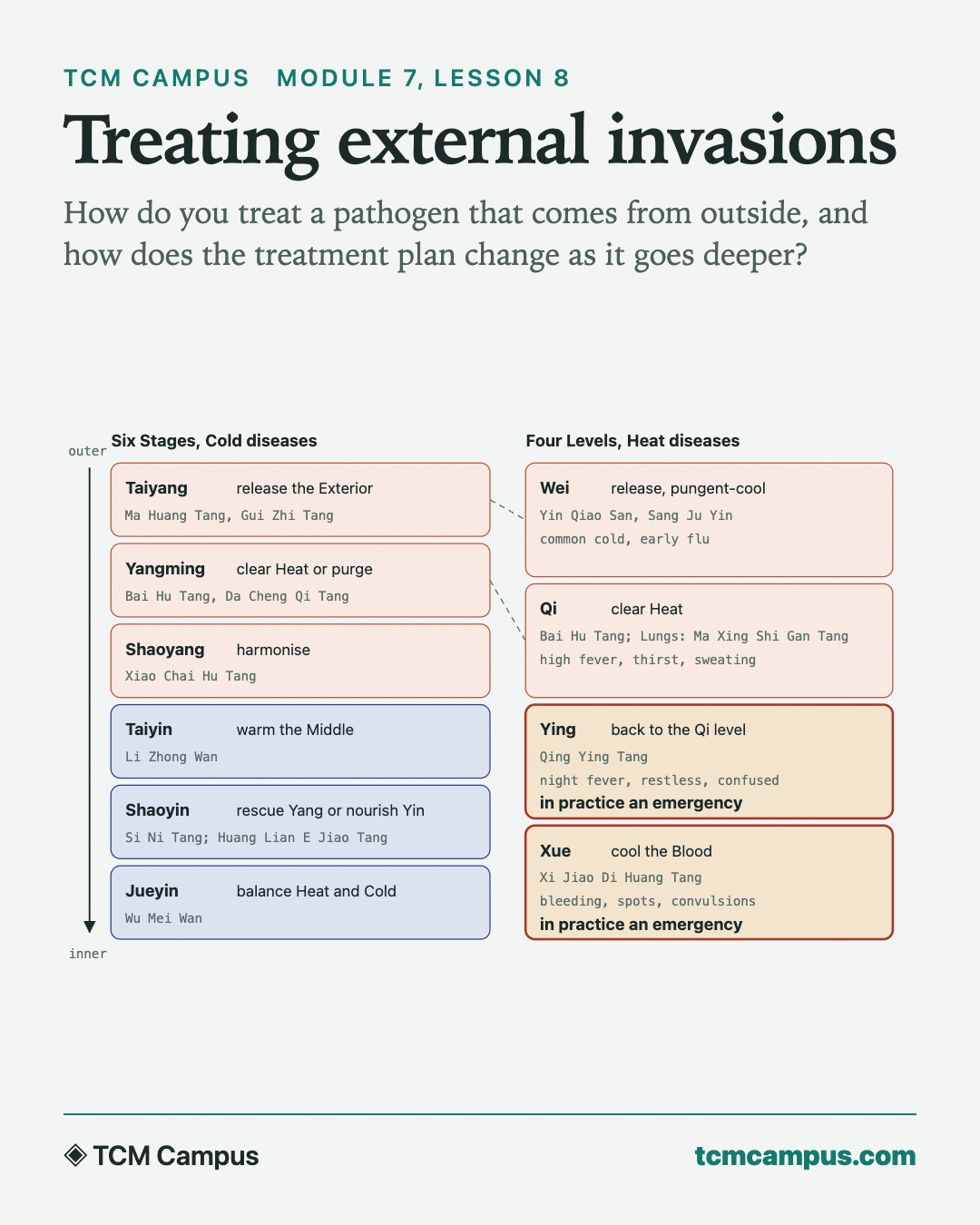
- Six Stages. Taiyang release (Ma Huang Tang, Gui Zhi Tang); Yangming clear or purge (Bai Hu Tang, Da Cheng Qi Tang); Shaoyang harmonise (Xiao Chai Hu Tang); Taiyin warm (Li Zhong Wan); Shaoyin rescue Yang or nourish Yin (Si Ni Tang, Huang Lian E Jiao Tang); Jueyin Wu Mei Wan. mnemonic: open, clear, hinge; warm, rescue, balance.
- Four Levels. Wei: Yin Qiao San. Qi: Bai Hu Tang, for the Lungs Ma Xing Shi Gan Tang. Ying: Qing Ying Tang, the Heat back to the Qi level. Xue: Xi Jiao Di Huang Tang, cool the Blood. mnemonic: release, clear, push back, cool.
- Points per layer. Exterior LU-7 with LI-4; Yangming LI-11, LI-4, ST-44, GV-14; Shaoyang TE-5 with GB-34; Taiyin CV-12, ST-36, BL-20 with moxa. mnemonic: hand and foot of the same level.
- Red flag. Fever with neck stiffness, drowsiness, spots that do not fade under pressure, or difficulty breathing; fever in an infant, a frail older person or after travel in the tropics; heat with confusion: emergency services (112 in Europe, 999 in the UK, 911 in North America) or the same day.
The rest of this lesson is reference.
Three practice questions from this lesson
Which picture does Ma Huang Tang fit?
- Taiyang, Cold, no sweat
- Taiyang, Wind, slight sweating
- Yangming channel, profuse sweating
Answer: Taiyang, Cold, no sweat. Ma Huang Tang opens a closed Exterior. With slight sweating Gui Zhi Tang, with the four greats Bai Hu Tang.
Which principle belongs to Shaoyang?
- Purge via the bowel
- Harmonise
- Induce sweating
Answer: Harmonise. The hinge, half outside, half inside: neither sweating nor purging, but harmonising with Xiao Chai Hu Tang.
What are the four greats of the Yangming channel pattern?
- Alternating chills and fever, bitter taste, nausea, fullness under the ribs
- High fever, profuse sweating, great thirst, big pulse
- Chills, stiff neck, headache, no sweat
Answer: High fever, profuse sweating, great thirst, big pulse. Chills, stiff neck, headache and no sweat is Taiyang; alternating chills and fever with a bitter taste, nausea and fullness under the ribs is Shaoyang.
The rest of this lesson
In the course you get the step-by-step explanation, 16 case-based practice questions, 21 spaced-repetition flashcards, the pitfalls and the bridge to physiology with evidence grades. This lesson belongs to module 7: Treatment.