All lessons Module 1: Foundations Lesson 11
Tongue diagnosis
What does a tongue you see in ten seconds tell you, and what does it not?
After this lesson you can read a tongue in the fixed order, lay the picture next to the nineteen patterns, and you know which features two raters see the same way.
Know by heart
- The reading order. Colour, shape, coating, moisture, zone; mnemonic: Cool Sharks Cruise Many Zones.
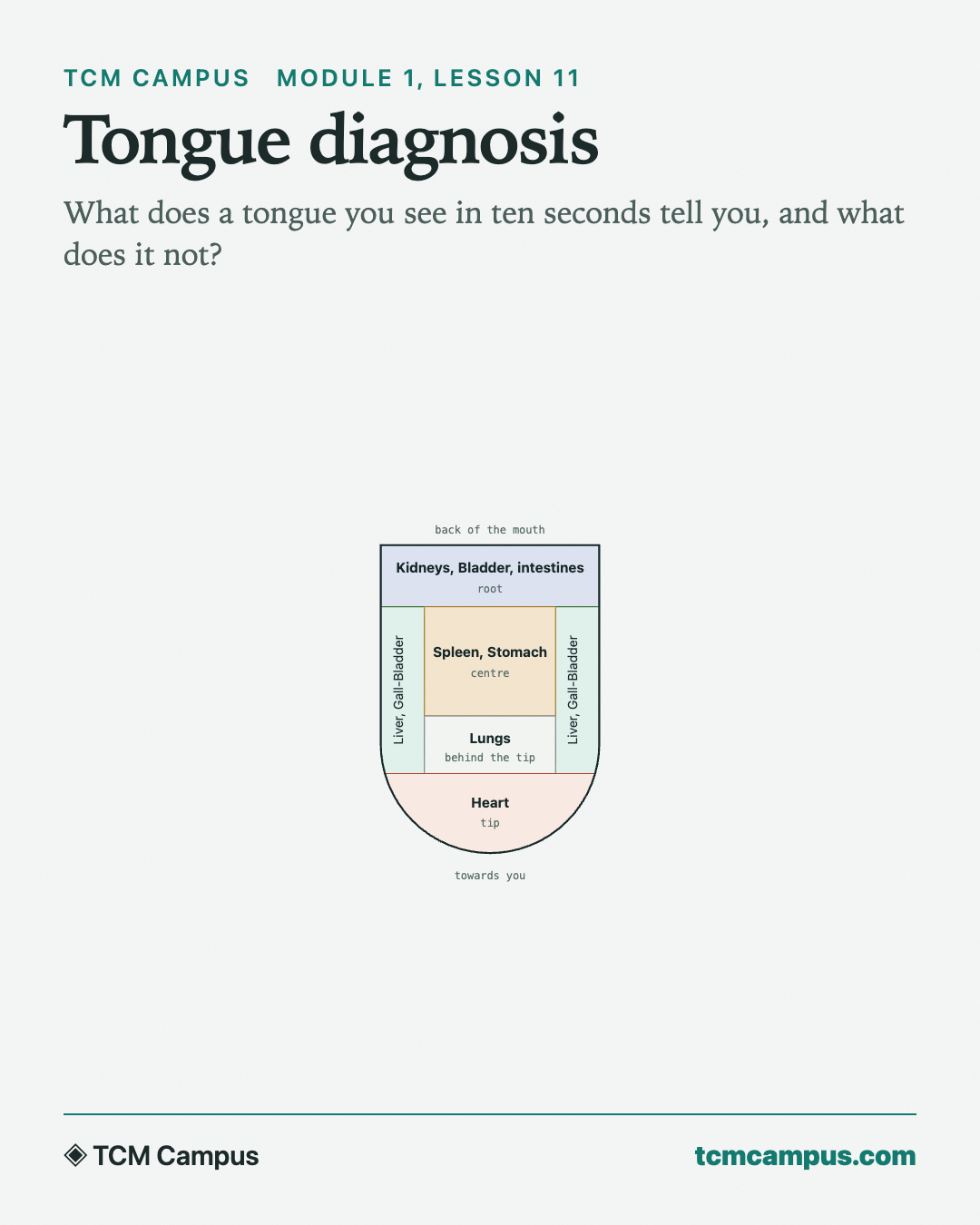
- The zones. Tip Heart; just behind the tip Lungs; centre Spleen and Stomach; sides Liver and Gall-Bladder; root Kidneys, Bladder and intestines; mnemonic: the trunk from top to bottom: Heart and Lungs at the front, Spleen and Stomach in the middle, Kidneys and intestines at the back; the Liver at the side, as in the abdomen.
- Colour. Pale: Qi or Blood deficiency; pale and wet: Yang deficiency. Red with coating: Full-Heat; red without coating: Yin deficiency with Empty-Heat. Purple: Blood stasis, bluish with Cold, reddish with Heat; mnemonic: with red, ask straight away "with or without coating?".
- Shape. Swollen with teeth marks: Spleen-Qi or Spleen-Yang deficiency with Dampness. Thin: Blood or Yin deficiency. Cracks: Yin deficiency; a central crack: Stomach or Heart.
- Coating. Thin white: normal, or the start of external Cold. Thick: Excess, a pathogen. Sticky yellow: Damp-Heat. Sticky white: Damp-Cold or Damp-Phlegm. Peeled or rootless: Yin deficiency of the Stomach or Kidneys; mnemonic: yellow is hot, white is cold, thick is full, gone is empty.
- Underside. Distended sublingual veins: Blood stasis; look with the tip against the palate.
- Two lessons from the patterns. Pale, wet, swollen is Spleen-Yang (7) and Kidney-Yang (12) alike, and the history decides; a normal tongue rules out nothing (1, 5, 17).
The rest of this lesson is reference.
Three practice questions from this lesson
A thick coating, whatever the colour, means
- Excess: a pathogen is present
- Deficiency: the zheng qi is running out
- Blood stasis: the Blood stands still
Answer: Excess: a pathogen is present. A thick coating is Excess. The coating is the footprint of a xie qi; no coating means precisely a deficit, zheng qi running out. Blood stasis you read from a purple tongue and distended sublingual veins, not from the coating.
Sticky yellow coating
- Damp-Cold
- Damp-Heat
- Yin deficiency of the Stomach
Answer: Damp-Heat. Sticky yellow is Damp-Heat; sticky white is Damp-Cold or Damp-Phlegm.
Teeth marks along the edge
- Liver-Qi stagnation: normal tongue or red sides
- Spleen-Qi or Spleen-Yang deficiency with Dampness
- Liver-Fire
Answer: Spleen-Qi or Spleen-Yang deficiency with Dampness. Swollen with teeth marks is Spleen-Qi or Spleen-Yang deficiency with Dampness. Liver-Qi stagnation has a normal tongue or red sides, Liver-Fire redder sides with a yellow coating; teeth marks belong to neither.
The rest of this lesson
In the course you get the step-by-step explanation, 18 case-based practice questions, 24 spaced-repetition flashcards, the pitfalls and the bridge to physiology with evidence grades. This lesson belongs to module 1: Foundations.