All lessons Module 5: Patterns Lesson 16
The Three Burners, and three models side by side
Where in the body does a Heat disease sit, and how do you lay the Six Stages, the Four Levels and the Three Burners over one patient?
After this lesson you know, for each Burner, the patterns with signs, tongue, pulse, principle and classical formula, and Wu Jutong's treatment rule, and you can place one finding in all three models. Formulas by name, without dosages.
Know by heart
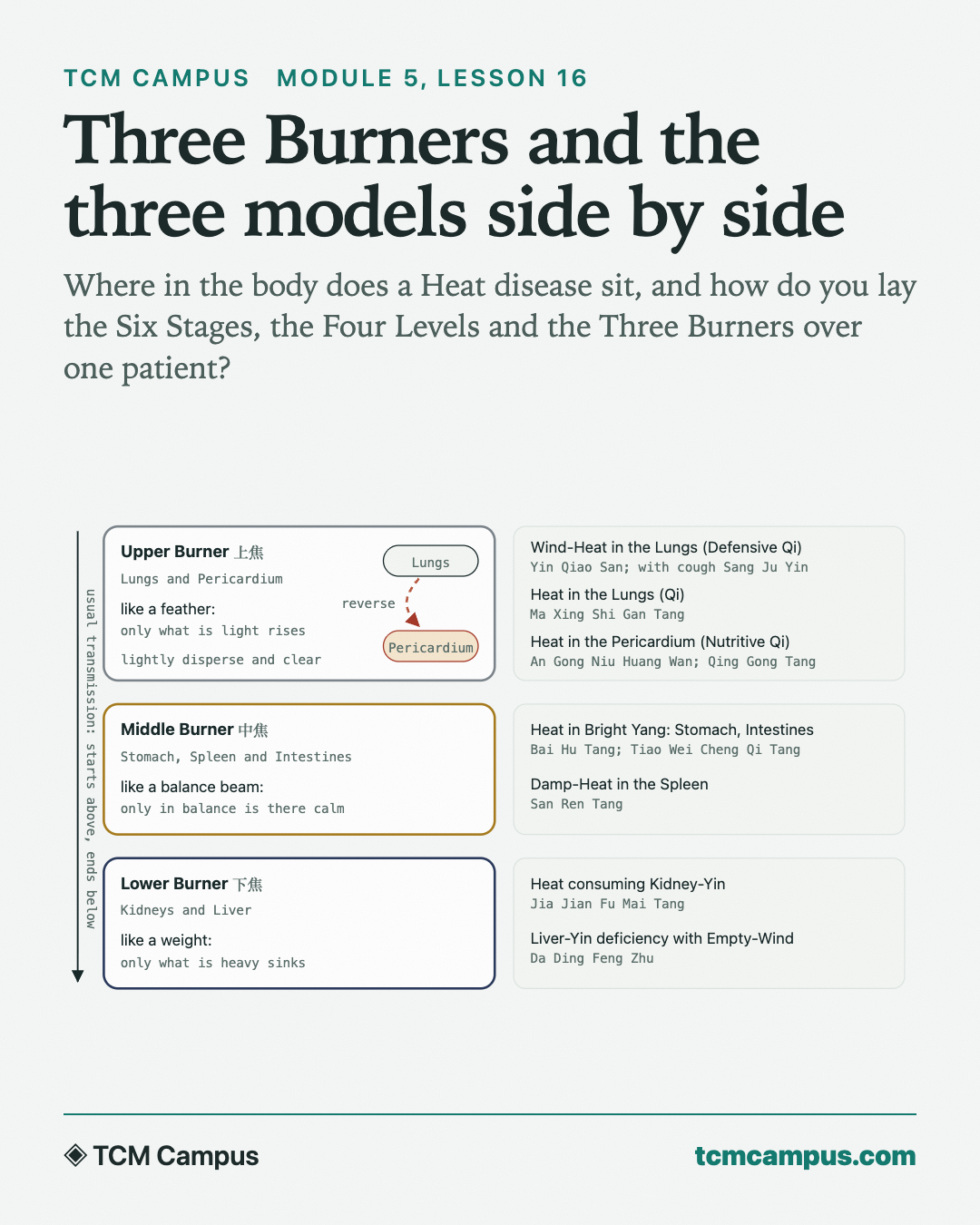
- Upper: Lungs and Pericardium. Wind-Heat in the Lungs (fever, slight aversion to cold, sore throat, cough; red tip; floating, rapid; Yin Qiao San, Sang Ju Yin). Lung-Heat (high fever, cough, breathlessness, yellow phlegm; Ma Xing Shi Gan Tang). Heat in the Pericardium (delirium, clouded consciousness; dark red; An Gong Niu Huang Wan).
- Middle: Stomach, Spleen, Intestines. Heat in Bright Yang (the four greats: Bai Hu Tang; afternoon fever with constipation: Tiao Wei Cheng Qi Tang). Damp-Heat in the Spleen (fever that does not come down with sweating, heaviness, oppression, little thirst; sticky yellow; soggy; San Ren Tang).
- Lower: Kidneys and Liver. Heat has consumed Kidney-Yin (low-grade fever, hot palms and soles, dry mouth, poor hearing; dark red without coating; pulse thin or empty; Jia Jian Fu Mai Tang). With trembling fingers as well: Empty-Wind, Da Ding Feng Zhu.
- Wu Jutong. Treat the Upper Burner like a feather, the Middle like a balance beam, the Lower like a weight. mnemonic: light, level, heavy.
- Course. Begins above, ends below; from the Lungs it can go in reverse to the Pericardium.
- Three models, three axes. Six Stages: Cold via the skin, depth along the channel levels, Yang injured first. Four Levels: Heat via the nose and mouth, depth in layers, Yin injured first. Three Burners: Heat, location from top to bottom. mnemonic: how deep in Cold, how deep in Heat, and where.
- Where they meet. Greater Yang and the Defensive Qi level are the exterior, at the top; Bright Yang is the Qi level in the Middle; the Pericardium (Nutritive Qi) is deep but at the top; the late Yin deficiency (Blood level) is the Lower Burner. The Cold stages Greater Yin and Lesser Yin Cold have no counterpart in the Heat models.
The rest of this lesson is reference.
Three practice questions from this lesson
Case. Woman, 28. Slightly feverish, mainly a tickly cough, slight thirst, throat a little raw. Tongue with a red tip. Pulse floating and rapid. Which Burner and formula?
- Upper, Sang Ju Yin
- Lower, Jia Jian Fu Mai Tang
- Middle, San Ren Tang
Answer: Upper, Sang Ju Yin. Wind-Heat in the Lungs, Upper Burner, with cough in the foreground: Sang Ju Yin. Light as a feather.
Case. Man, 63. High fever without chills, cough with yellow phlegm, breathless, thirsty. Tongue red, yellow coating. Pulse rapid and full. Which pattern, and what comes first?
- Middle, Bright Yang; give Bai Hu Tang first
- Upper, Lung-Heat; the GP or primary care doctor the same day
- Upper, Wind-Heat; the GP or primary care doctor within a week
Answer: Upper, Lung-Heat; the GP or primary care doctor the same day. Lung-Heat in the Upper Burner (Qi level), with Ma Xing Shi Gan Tang as the classical formula. No more chills and yellow phlegm: not Wind-Heat. Breathlessness with high fever is pneumonia until proven otherwise: that does not wait a week.
Case. Woman, 79, with flu becomes restless and confused at night, the fever rises, her tongue is dark red. Which Burner, and what do you do?
- Upper, the Pericardium; emergency services
- Middle, Bright Yang; wait and see
- Lower, Kidney-Yin; nourish Yin first
Answer: Upper, the Pericardium; emergency services. Heat in the Pericardium, in the Upper Burner, even though it is deep (Nutritive Qi). Confused with fever in an older person: emergency services, not waiting and not nourishing first.
The rest of this lesson
In the course you get the step-by-step explanation, 15 case-based practice questions, 20 spaced-repetition flashcards, the pitfalls and the bridge to physiology with evidence grades. This lesson belongs to module 5: Patterns.