All lessons Module 2: Organs Lesson 12
The transformations of Qi
What has to happen before a sandwich becomes Qi, Blood and urine, and where does it get stuck?
After this lesson you can explain what Qi transformation (qi hua) and the Qi Mechanism (qi ji) are, say for each organ which way its Qi goes and why the centre is the pivot, see how the Triple Burner carries the transformation at each level, and read a picture as failing transformation or as movement gone astray. Yuan Qi and Ming Men came in lesson 6 of this module; the four directions of module 1, lesson 3 get their organs here.
Know by heart
- Qi hua and qi ji. Qi hua is the transformation (food into Qi and Blood, fluid into sweat and urine); qi ji is the movement that carries it: ascending, descending, entering, exiting. mnemonic: hua is the kitchen, ji is the traffic.
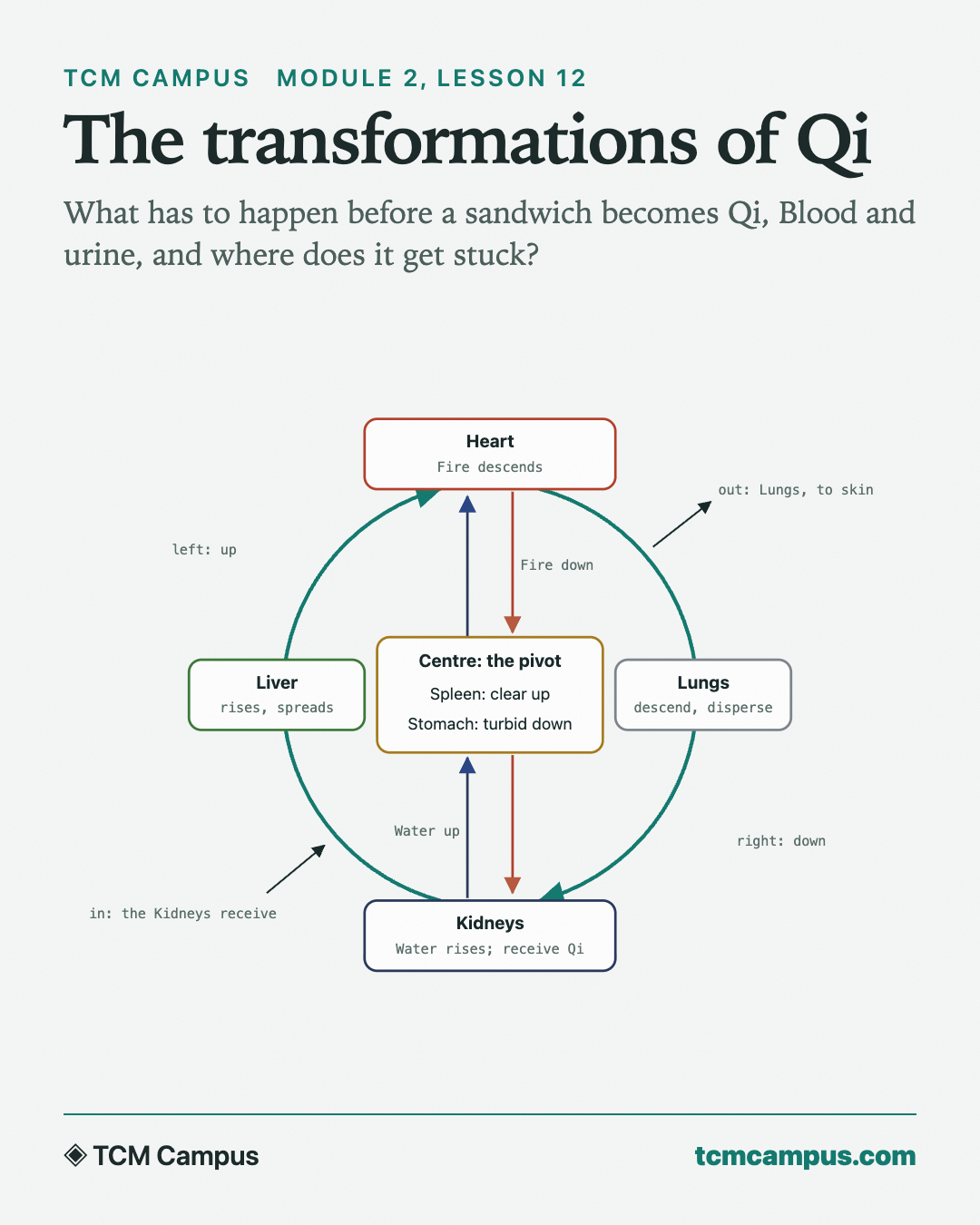
- Who goes which way. The Liver and Spleen ascend; the Lungs and Stomach descend; the Fire of the Heart descends, the Water of the Kidneys rises, and the Kidneys receive the Qi. mnemonic: left up, right down; Fire down, Water up.
- The centre is the pivot. The Spleen sends the clear upwards, the Stomach the turbid downwards; if the axle stands still, all the other movements falter.
- Su Wen 68. Without entering and exiting, no birth, growth and ageing; without ascending and descending, no growth, transformation and storage; every organ does all four (paraphrase).
- Su Wen 5. Yang transforms into Qi, Yin takes on form: if the Yang is too weak to transform, Yin accumulates as Dampness, Phlegm, oedema or a mass.
- The Triple Burner as workshop. Yuan Qi from Ming Men drives the transformation at each level: the upper spreads, the middle transforms, the lower separates and excretes; the Bladder excretes via Qi transformation (Su Wen 8).
- Two kinds of failure. The transformation fails (deficiency: too little Yang or Qi; excess: something blocks the workshop) or the movement goes astray (stagnation, sinking, rebellion, from module 1, lesson 3); more in ch. 29, module 5.
The rest of this lesson is reference.
Three practice questions from this lesson
What is the difference between qi hua and qi ji?
- Qi hua is moving, qi ji is transforming
- They are two words for the same transformation
- Qi hua is transforming, qi ji is moving
Answer: Qi hua is transforming, qi ji is moving. Hua is the kitchen (from food to Qi, from fluid to urine), ji the traffic (ascending, descending, in, out) that carries the transformation. They belong together, but they are not the same.
Which two organs ascend in the wheel?
- Heart and Lungs
- Lungs and Stomach
- Liver and Spleen
Answer: Liver and Spleen. Left up: the Liver and Spleen. Right down: the Lungs and Stomach (Su Wen 52, paraphrase).
Why is the centre called the pivot?
- Because Heart and Kidneys exchange Fire and Water there
- Because Liver and Lungs balance each other there
- Spleen sends the clear up, Stomach the turbid down
Answer: Spleen sends the clear up, Stomach the turbid down. Everything turns around that: if the axle stands still, the Lungs and Heart get too little and the route down gets blocked. The Heart and Kidneys form the vertical axis, the Liver and Lungs the sides of the wheel.
The rest of this lesson
In the course you get the step-by-step explanation, 13 case-based practice questions, 13 spaced-repetition flashcards, the pitfalls and the bridge to physiology with evidence grades. This lesson belongs to module 2: Organs.