All lessons Module 3: Causes Lesson 1
The emotions as a cause, in depth
When does a feeling make someone ill, and how do you read which emotion affects which organ?
After this lesson you know when an emotion becomes a cause, you know for each emotion the movement of Qi, the organ and the clinical picture from ch. 20, you can link each emotion to the patterns from module 1, and you can tell cause from consequence.
Know by heart
- When it becomes a cause. Only when it is intense or prolonged, and above all when the emotion is not acknowledged or expressed; an ordinary feeling does not make you ill. mnemonic: too strong, too long or bottled up.
- Seven in the book. Anger, joy, sadness, worry, pensiveness, fear, shock (ch. 20 pp. 259 to 265). Fear is kong, shock is jing; other English texts call jing fright.
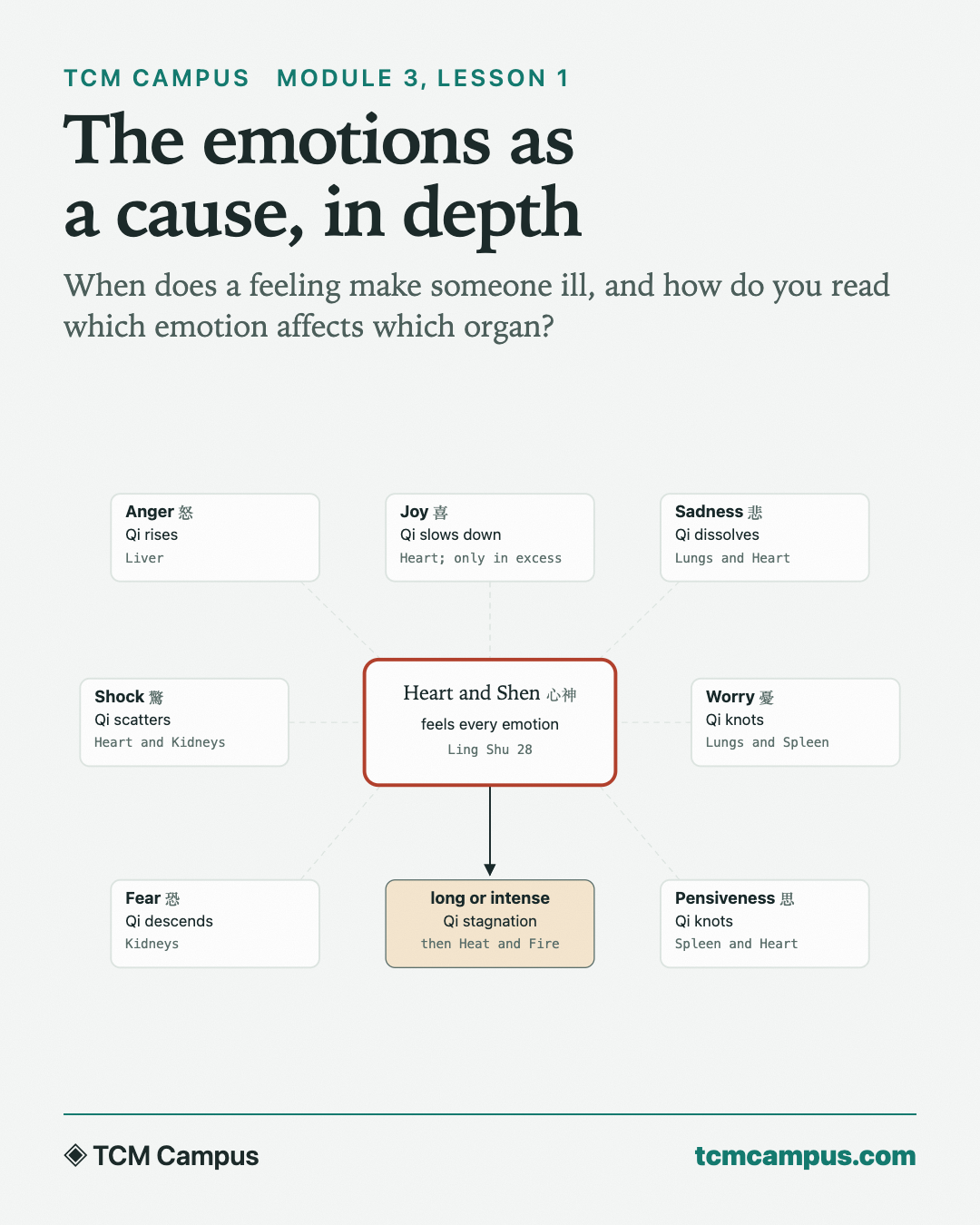
- The Qi (Su Wen 39). Anger rises, joy slows down, sadness dissolves, worry and pensiveness knot, fear descends, shock scatters. mnemonic: hit the roof, ease off, deflate, tie yourself in knots, heart in your boots, go to pieces.
- The organ. Anger the Liver; joy the Heart; sadness the Lungs and Heart; worry the Lungs and Spleen; pensiveness the Spleen and Heart; fear the Kidneys; shock the Heart and Kidneys. And every emotion affects the Heart, because the Shen feels it (Ling Shu 28).
- The end route. What stays stuck for long becomes Qi stagnation; stagnant Qi turns into Heat and Fire, which consume Yin; Blood stasis and Phlegm can also follow. mnemonic: stuck, hot, dry.
- Two directions. An emotion makes an organ ill, and an ill organ colours the mood: Liver-Blood deficiency makes you irritable, Heart-Blood deficiency mildly anxious. Always ask what came first.
- Emotions restrain each other (Su Wen 5). Sadness overcomes anger, fear overcomes joy, anger overcomes pensiveness, joy overcomes worry, pensiveness overcomes fear: the controlling sequence from module 1, lesson 4.
The rest of this lesson is reference.
Three practice questions from this lesson
When does an emotion become a cause of disease?
- Only when the matching organ is already deficient
- When intense or prolonged, especially if unexpressed
- As soon as it occurs, even a brief ordinary feeling
Answer: When intense or prolonged, especially if unexpressed. Too strong, too long or bottled up. An ordinary feeling is part of life and does not make you ill, and a deficient organ is not a precondition.
Which emotion makes Qi descend?
- Shock (jing)
- Sadness (bei)
- Fear (kong)
Answer: Fear (kong). Su Wen 39: fear (kong) makes Qi descend. Shock scatters it, sadness dissolves it.
According to Ling Shu 28, which organ does every emotion affect?
- The Heart
- The Kidneys
- The Liver
Answer: The Heart. Sadness and worry move the Heart, and a moved Heart makes all the organs tremble: the Shen feels every emotion.
The rest of this lesson
In the course you get the step-by-step explanation, 16 case-based practice questions, 18 spaced-repetition flashcards, the pitfalls and the bridge to physiology with evidence grades. This lesson belongs to module 3: Causes.