All lessons Module 5: Patterns Lesson 3
The Eight Principles in depth
How do you turn four questions into a diagnosis that still holds when the answers contradict each other?
Module 1, lesson 2 gave you the four questions; this lesson gives you the answers that do not fit into one box. After this lesson you know the ten methods of Part 6 and when each one fits, you separate Exterior from "from outside", you distinguish five kinds of Heat, you recognise the five combinations of Heat and Cold, and you recognise collapse of Yin and of Yang as an emergency picture.
Know by heart
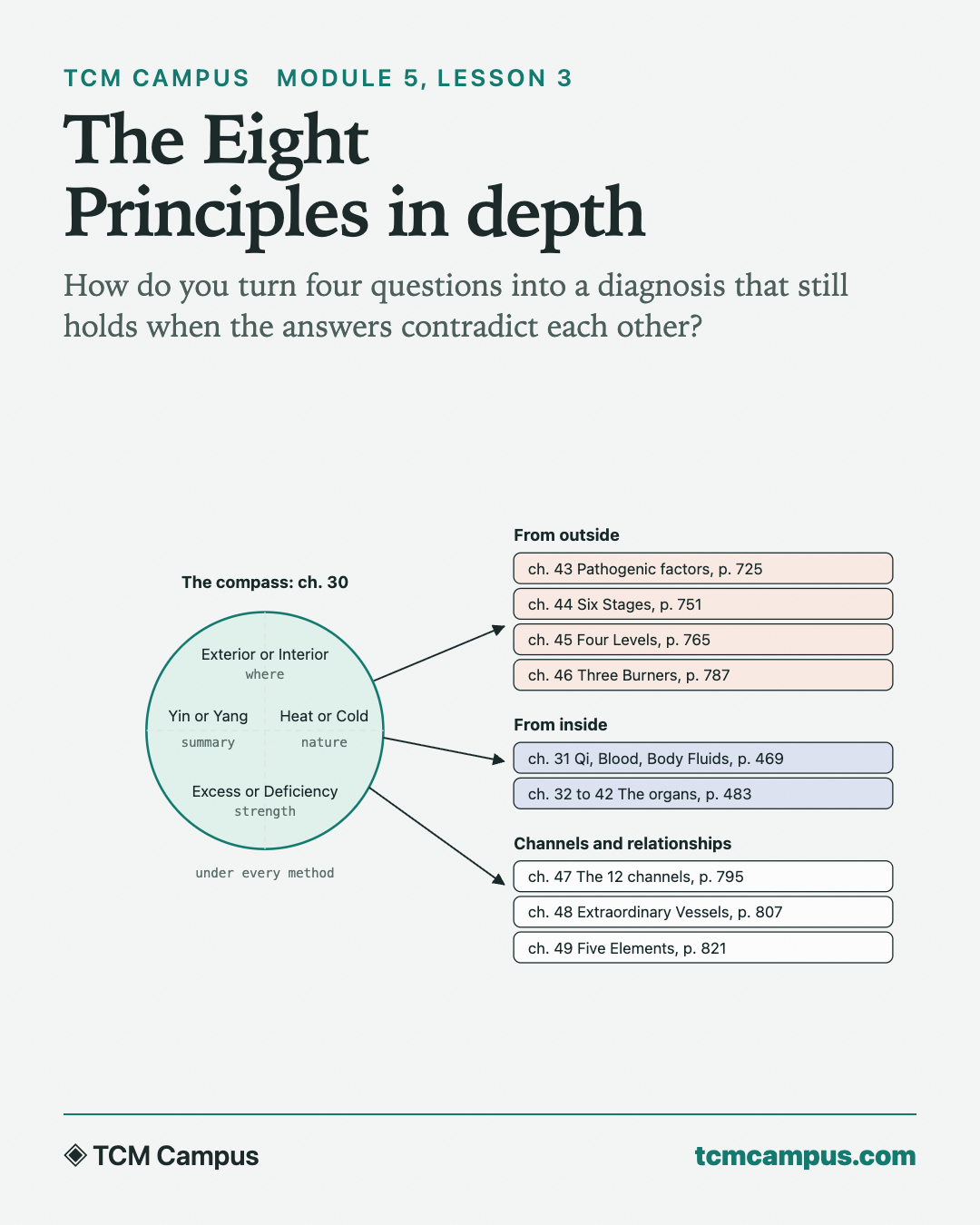
- The compass under every map. Four pairs: Exterior or Interior (where), Heat or Cold (nature), Excess or Deficiency (strength), Yin or Yang (summary). They lie under all ten methods of Part 6. mnemonic: one needle, ten maps.
- Which map when. From outside: pathogenic factors, Six Stages (Cold), Four Levels and Three Burners (Heat). From inside: Qi, Blood and Body Fluids, and the organs. In the channel: 12 channels and Extraordinary Vessels. Relationships: Five Elements.
- Exterior is a layer, not a cause. Aversion to cold and fever at the same time, floating pulse, head and neck, aching muscles. Exterior-Cold of the Excess type: no sweating, pulse tight; of the Deficiency type: sweating without relief. Cold and Dampness can also penetrate straight to the Interior (Stomach, intestines, uterus). mnemonic: if the pulse floats, it is on the Exterior.
- Five kinds of Heat. Full (yellow coating, full-rapid); Empty (no coating, thin-rapid); Damp-Heat (sticky yellow, slippery-rapid); from stagnation (red sides, wiry); in the Blood (dark red tongue, bleeding). mnemonic: yellow, bare, sticky, sides, dark.
- Five combinations of Heat and Cold. Cold outside, Heat inside; Heat outside, Cold inside; Heat above, Cold below; true Heat, false Cold; true Cold, false Heat. mnemonic: outside, above or false; the core does not lie: thirst, urine, trunk, tongue.
- Yin and Yang: summary and extreme. Su Wen 5: a good diagnostician first distinguishes Yin and Yang. Collapse of Yang: cold sweat, cold limbs, pulse almost gone. Collapse of Yin: sweat like oil, warm skin, thirst, pulse empty and rapid. Both: emergency services.
- One label in a fixed order. Where, nature, strength: "Interior, Heat, Deficiency" is Yin deficiency with Empty-Heat. Any answer may be "both"; then it is called a combination, not a mistake. mnemonic: four Ws: Where, What kind, Who wins, Which pole.
The rest of this lesson is reference.
Three practice questions from this lesson
A febrile disease that comes from outside and starts as Heat. Which method of Part 6 do you use to follow its course?
- Four Levels (ch. 45)
- Five Elements (ch. 49)
- 12 channels (ch. 47)
Answer: Four Levels (ch. 45). You follow Heat invasions with the Four Levels and the Three Burners; Cold invasions with the Six Stages. Textbook knowledge; the introduction to Part 6 is on pp. 440 to 446.
Which combination makes a picture 'Exterior'?
- A cause from outside, such as cold or a draught
- Chills and fever together, floating pulse
- An acute, fierce onset with high fever
Answer: Chills and fever together, floating pulse. Exterior is a layer: aversion to cold or chills and fever at the same time, with a floating pulse. Acute can also be Interior, and a cause from outside can go straight inside.
Case. Woman, 27, quickly drank two glasses of ice water on a hot day; now cramping abdominal pain, better with a hot-water bottle, worse with pressure. No fever, no chills, pulse deep and tight. Exterior or Interior?
- Interior: Full-Cold in the Stomach and intestines
- Exterior-Cold, Excess: the cause came from outside
- Empty-Cold: chronically cold, Yang deficiency
Answer: Interior: Full-Cold in the Stomach and intestines. Cold can penetrate straight to the Interior (textbook knowledge): Interior, coming from outside. No chills and no floating pulse: no Exterior pattern, even though the cause came from outside. Acute, cramping and worse with pressure: Excess, not Empty-Cold. First: rule out a surgical abdomen if the pain persists.
The rest of this lesson
In the course you get the step-by-step explanation, 16 case-based practice questions, 17 spaced-repetition flashcards, the pitfalls and the bridge to physiology with evidence grades. This lesson belongs to module 5: Patterns.