All lessons Module 1: Foundations Lesson 8
Relationships and combinations
How does one pattern become two, and which do you treat first?
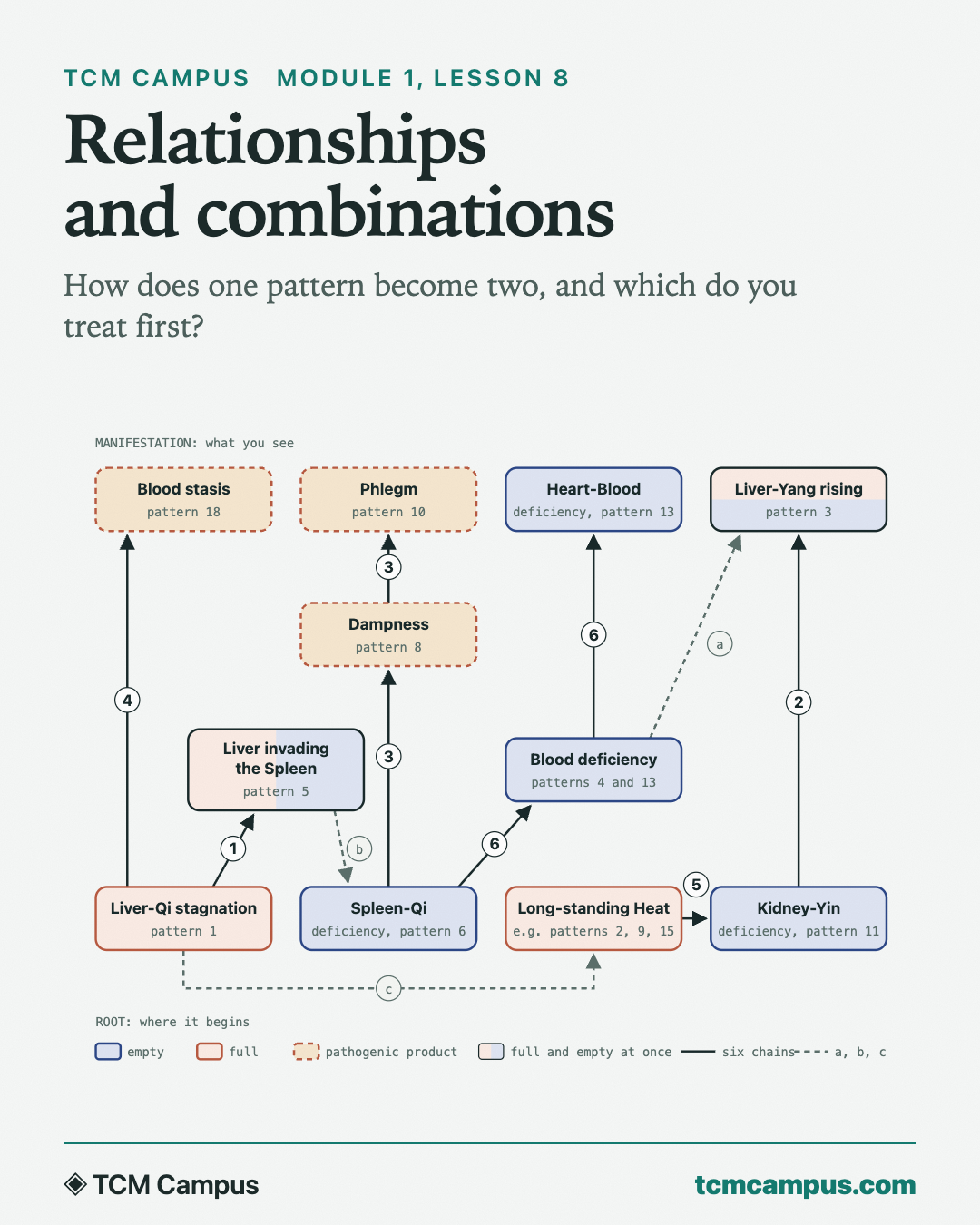
How do the nineteen patterns hang together? After this lesson you can draw the six chains from memory, separate root and manifestation, and recognise seven secondary patterns with their formula.
Know by heart
- Six chains. 1 Liver-Qi stagnation leads to Liver invading the Spleen; 2 Kidney-Yin deficiency leads to Liver-Yang rising; 3 Spleen-Qi deficiency gives Dampness, Dampness gives Phlegm; 4 Qi stagnation leads to Blood stasis; 5 long-standing Heat leads to Yin deficiency; 6 Spleen-Qi deficiency gives Blood deficiency, which gives Heart-Blood deficiency. mnemonic: stress presses on the gut (1) and congeals the Blood (4); a weak Spleen makes Phlegm (3) and too little Blood (6); Heat eats Yin (5); empty Kidneys, rising Yang (2).
- Two roots, four branches. Liver-Qi stagnation feeds chains 1 and 4, Spleen-Qi deficiency chains 3 and 6; so always ask about stress and digestion.
- Root and Manifestation. Acute: the manifestation first; chronic: the root; often both at once. The manifestation is often an excess, the root often a deficiency; Liver-Qi stagnation is the exception: an excess and a root. mnemonic: 本 ben is a tree, 木, with a stroke at the root.
- Root of Liver-Yang rising. Yin or Blood deficiency; the tongue follows the root: red with little coating is Yin, pale and thin is Blood.
- Recognise, with formula. Spleen-Qi sinking: Bu Zhong Yi Qi Tang; Spleen not controlling Blood: Gui Pi Tang; Phlegm misting the Mind: Wen Dan Tang; Retention of Food: Bao He Wan. Without a set formula: Kidney-Essence deficiency, Stomach-Heat, Liver-Wind. mnemonic: Bu Zhong lifts the Centre, Gui Pi goes back to the Spleen.
- Five axes, ten relationships (ch. 12). Axes: Liver and Spleen, Heart and Kidneys, Lungs and Kidneys, Spleen and Kidneys, Heart and Spleen. Ten: five organs, each with the four others.
The rest of this lesson is reference.
Three practice questions from this lesson
Case. Man, 41, busy job. Tense shoulders for years, sighs a lot, irritable. For six months, abdominal pain and alternating stools, worse in busy weeks. Pulse taut on the left, weak on the right.
- Chain 3: Spleen-Qi deficiency gives Dampness, Dampness gives Phlegm
- Chain 4: Qi stagnation leads to Blood stasis
- Chain 1: Liver-Qi stagnation leads to Liver invading the Spleen
Answer: Chain 1: Liver-Qi stagnation leads to Liver invading the Spleen. First the Liver picture (tension, sighing, irritable: pattern 1), then the gut moving with the stress: pattern 5. The pulse draws the axis: wiry on the left at the Liver, weak on the right at the Spleen. No heaviness or phlegm (chain 3), no fixed stabbing pain (chain 4).
Case. Woman, 38, PMS for ten years with tense breasts and mood swings. Now stabbing period pain in one fixed place, with dark clots. Tongue purplish at the sides.
- Chain 5: long-standing Heat leads to Yin deficiency
- Chain 1: Liver-Qi stagnation leads to Liver invading the Spleen
- Chain 4: Qi stagnation leads to Blood stasis
Answer: Chain 4: Qi stagnation leads to Blood stasis. Years of stagnation make the Blood congeal: fixed stabbing pain, dark clots, a purple tongue (pattern 18). Purple at the sides points to the zone of the Liver and Gall-Bladder. New or increasing period pain: have endometriosis or fibroids ruled out first.
Case. Man, 55, years of a lot of alcohol and spicy food, used to be often flushed and hot-tempered. Now night sweats, a dry mouth at night, hot soles. Tongue red, peeled in the centre.
- Chain 6: Spleen-Qi deficiency gives Blood deficiency
- Chain 2: Kidney-Yin deficiency leads to Liver-Yang rising
- Chain 5: long-standing Heat leads to Yin deficiency
Answer: Chain 5: long-standing Heat leads to Yin deficiency. Years of Full-Heat consume the Yin. A peeled tongue is Yin deficiency of the Stomach or Kidneys, here in the centre: the Stomach. The excess has created a new root. Alcohol and night sweats also call for an ordinary check: liver function tests and, with weight loss, the B symptoms.
The rest of this lesson
In the course you get the step-by-step explanation, 26 case-based practice questions, 25 spaced-repetition flashcards, the pitfalls and the bridge to physiology with evidence grades. This lesson belongs to module 1: Foundations.