All lessons Module 4: Diagnosis Lesson 7
Pulse 1: positions, levels and the healthy pulse
Where do you put your fingers, how deep do you press, and what does a pulse with nothing wrong feel like?
After this lesson you can explain why the pulse is taken at the wrist, you know the logic behind the six positions and the five depths of the Nan Jing, you feel according to a fixed protocol, you can describe a healthy pulse with Shen, Stomach-Qi and root, and you know what season, age and training change in a normal pulse. The qualities themselves are lesson 8.
Know by heart
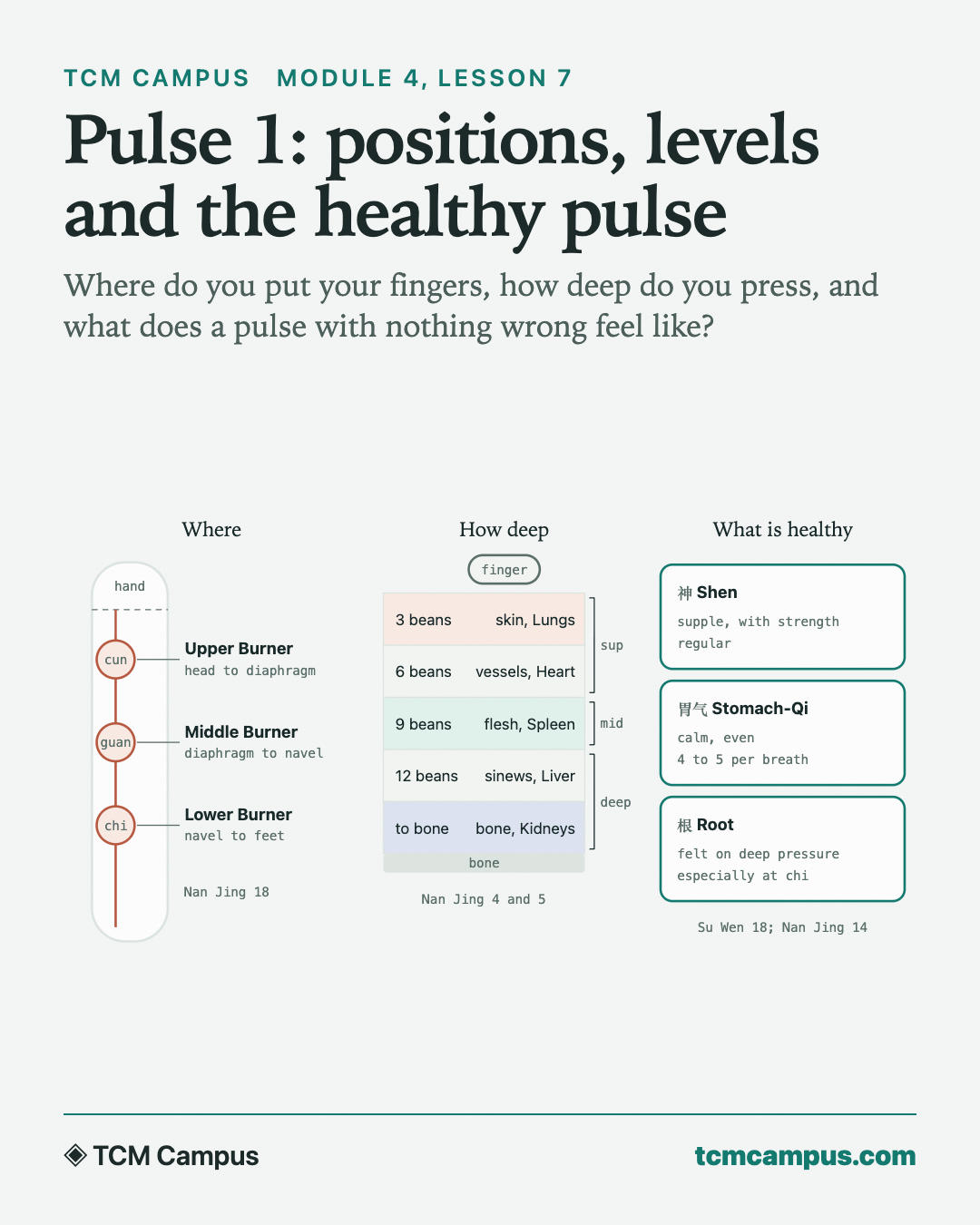
- Why at the wrist. The cun kou lies on the Lung channel: there the vessels meet (Nan Jing 1), and there the Stomach, source of Qi for all the organs, shows itself (Su Wen 11); mnemonic: the Lungs receive the hundred vessels (Su Wen 21).
- Three positions, three Burners. Cun: head to diaphragm; guan: diaphragm to navel; chi: navel to feet (Nan Jing 18). Right chi is Kidney-Yang or Ming Men (Nan Jing 36: on the left the Kidney, on the right Ming Men); mnemonic: the pulse is a person lying down, head towards the hand.
- Five depths. Three beans Lungs (skin), six Heart (vessels), nine Spleen (flesh), twelve Liver (sinews), down to the bone Kidneys (Nan Jing 5); mnemonic: three more beans each time, from skin to bone.
- Three techniques. Ju lifting, an pressing, xun searching; first three fingers together, then each one separately; at least fifty beats (Ling Shu 5); mnemonic: light, heavy, hunt around.
- The healthy pulse. Shen: supple with strength, regular. Stomach-Qi: calm, even, four to five beats per breath (Su Wen 18). Root: felt on deep pressure, especially at chi (Nan Jing 14); mnemonic: spirit, stomach, root; the root must always be there.
- The pulse follows the season. Spring wiry, summer overflowing, autumn floating, winter deep (Nan Jing 15); mnemonic: string, wave, feather, stone.
- Red flags. A pulse that is missing or much weaker on one arm: blood pressure on both arms; with a cold, pale, painful arm: emergency services. A sick patient with a pulse without root and without Stomach-Qi: do not interpret, refer.
The rest of this lesson is reference.
Three practice questions from this lesson
According to Su Wen 11, why does the pulse at the wrist show the state of the five Zang?
- Because the Qi of the Stomach shows itself there
- Because the Heart lies closest to the skin there
- Because the Kidneys have their opening there
Answer: Because the Qi of the Stomach shows itself there. The Stomach is the sea of food and the source of Qi for all the organs; its Qi nourishes the five Zang and shows itself at the pulse of the hand-Taiyin. Nan Jing 1 adds: there the vessels meet.
Nan Jing 5 measures depth in beans. Which organ do you feel at twelve beans?
- Spleen
- Lungs
- Liver
Answer: Liver. Three Lungs (skin), six Heart (vessels), nine Spleen (flesh), twelve Liver (sinews), down to the bone Kidneys.
Which tissue belongs to the layer of three beans?
- The vessels, of the Heart
- The flesh, of the Spleen
- Skin and body hair
Answer: Skin and body hair. Each layer has the tissue of its organ: three beans the Lungs with skin and hair at the top, six the Heart with the vessels, nine the Spleen with the flesh, and at the bottom the Kidneys with the bone.
The rest of this lesson
In the course you get the step-by-step explanation, 16 case-based practice questions, 21 spaced-repetition flashcards, the pitfalls and the bridge to physiology with evidence grades. This lesson belongs to module 4: Diagnosis.