All lessons Module 1: Foundations Lesson 17
Treatment principles, modalities, herbs and safety
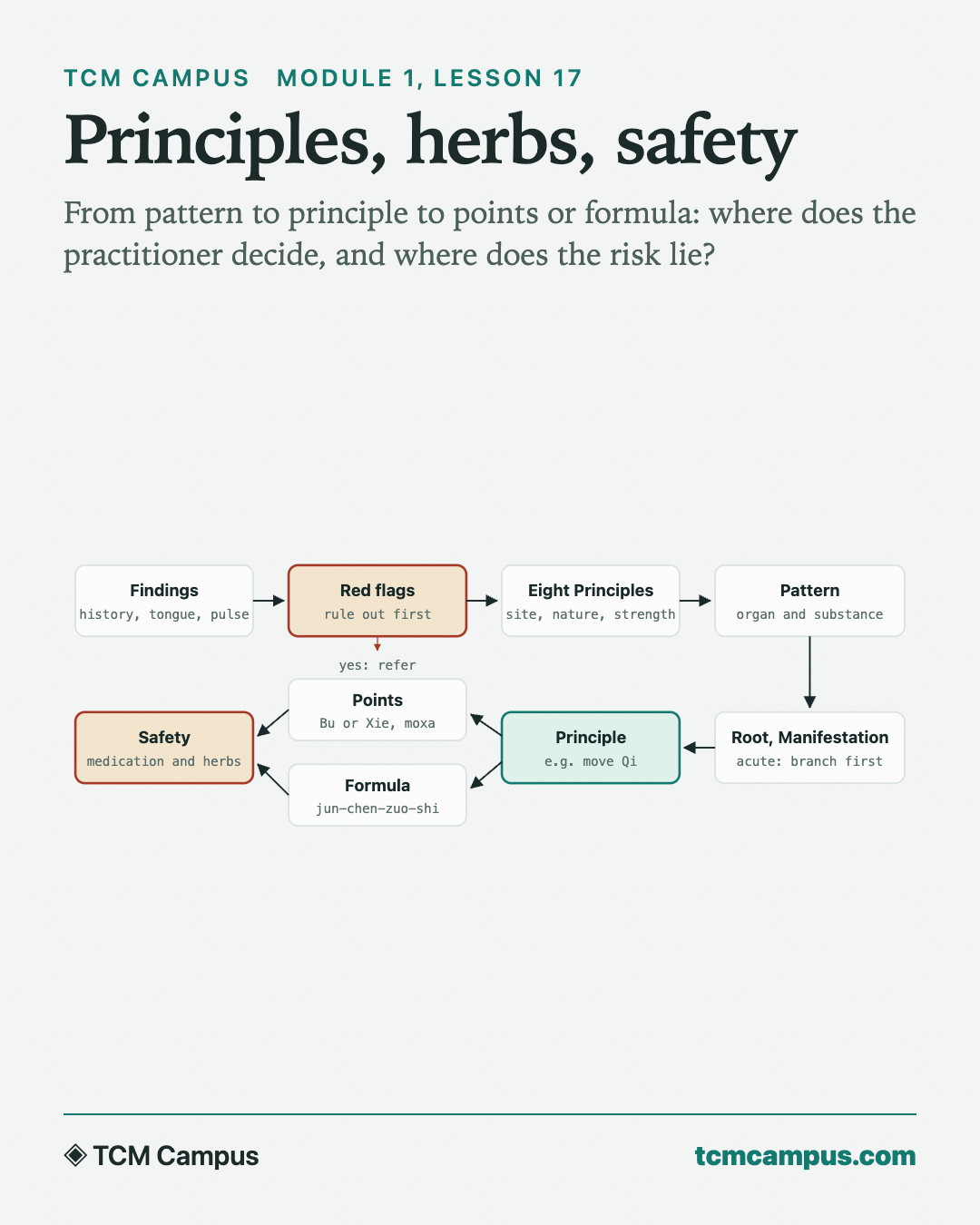
From pattern to principle to points or formula: where does the practitioner decide, and where does the risk lie?
After this lesson you can link six principles to pattern, points and formula, read a formula as emperor, minister, assistant and envoy, and for each risky herb you know what goes wrong, in whom, and what to ask and measure.
Know by heart
- Six principles and their patterns. Move Liver-Qi (1), tonify Spleen-Qi (6), nourish Kidney-Yin (11), clear Heat (2, 15, 17), transform Dampness (8, 10), move Blood (18). mnemonic: two move (Qi, Blood), two fill (Spleen-Qi, Kidney-Yin), two clear out (Heat, Dampness).
- Ten basic formulas and their patterns. Si Jun Zi Tang (6), Si Wu Tang (4), Xiao Yao San (5), Liu Wei Di Huang Wan (11), Jin Gui Shen Qi Wan (12), Bu Zhong Yi Qi Tang (sinking), Gui Pi Tang (13), Er Chen Tang (10), Xue Fu Zhu Yu Tang (18), Yin Qiao San (17). mnemonic: Si, Si and Liu count their herbs (four, four, six); the two Wan are the Kidney pills.
- The first choice. Zheng qi weak: tonify (Bu). Xie qi present: expel (Xie). Both: first whatever predominates. Acute: the Manifestation; chronic: the Root. mnemonic: don't lock the thief inside.
- Six modalities and their limits. Needle (Bu or Xie), electricity (2 Hz enkephalin and endorphin, 100 Hz dynorphin; not with a pacemaker without consultation), moxa (Yang deficiency and Cold; not in Empty-Heat), cupping, gua sha (caution with anticoagulants), ear.
- Five tastes. Pungent disperses, sweet tonifies, sour holds in, bitter dries and drains, salty softens. mnemonic: pungent goes out, sweet fills up, sour squeezes shut, bitter pulls down, salty softens.
- Jun, chen, zuo, shi. Emperor (main action), minister (reinforces), assistant (helps or tempers), envoy (guides and harmonises). Si Jun Zi Tang: Ren Shen, Bai Zhu, Fu Ling, Zhi Gan Cao. mnemonic: the emperor decides, the minister supports, the assistant corrects, the envoy delivers.
- Safety: the five questions above, and six herbs. Aristolochic acid: kidney, later urothelium. Gan Cao: blood pressure up, potassium down. Ma Huang: sympathomimetic. He Shou Wu: liver (HLA-B*35:01). Dan Shen and Dang Gui: INR up. Fu Zi: sodium channels, rhythm. mnemonic: A and G on the kidney, M and F on the heart, H on the liver, D on the blood.
The rest of this lesson is reference.
Three practice questions from this lesson
Which pattern goes with the principle 'nourish Kidney-Yin'?
- Liver-Fire (2)
- Kidney-Yang deficiency (12)
- Heart-Fire (15)
- Kidney-Yin deficiency (11)
Answer: Kidney-Yin deficiency (11). Pattern 11: KI-3, KI-6, SP-6, CV-4 and Liu Wei Di Huang Wan.
Which basic formula goes with Blood stasis (18)?
- Bu Zhong Yi Qi Tang
- Si Wu Tang
- Xue Fu Zhu Yu Tang
- Gui Pi Tang
Answer: Xue Fu Zhu Yu Tang. Si Wu Tang nourishes Blood (4), Gui Pi Tang nourishes Heart-Blood together with the Spleen (13), Bu Zhong Yi Qi Tang tonifies Spleen-Qi and raises the Yang (sinking).
Stress, alternating stools and distension, with signs of Blood deficiency. Which of the ten?
- Xiao Yao San
- Liu Wei Di Huang Wan
- Si Jun Zi Tang
- Yin Qiao San
Answer: Xiao Yao San. Pattern 5 Liver invading the Spleen: Tong Xie Yao Fang, and Xiao Yao San when Blood deficiency plays a part.
The rest of this lesson
In the course you get the step-by-step explanation, 20 case-based practice questions, 27 spaced-repetition flashcards, the pitfalls and the bridge to physiology with evidence grades. This lesson belongs to module 1: Foundations.