All lessons Module 7: Treatment Lesson 4
Point combinations 2: left and right, Yin and Yang, front and back
When does an acupuncturist choose the side opposite the complaint, and why combine a point on the front with a point on the back of the same organ?
After this lesson you can choose with reasons between both sides, the same side and the opposite side; combine a Yin channel with a Yang channel, also as Yuan and Luo; combine Front-Mu and Back-Shu with the reason from Nan Jing 67; and test a set against five balances.
Know by heart
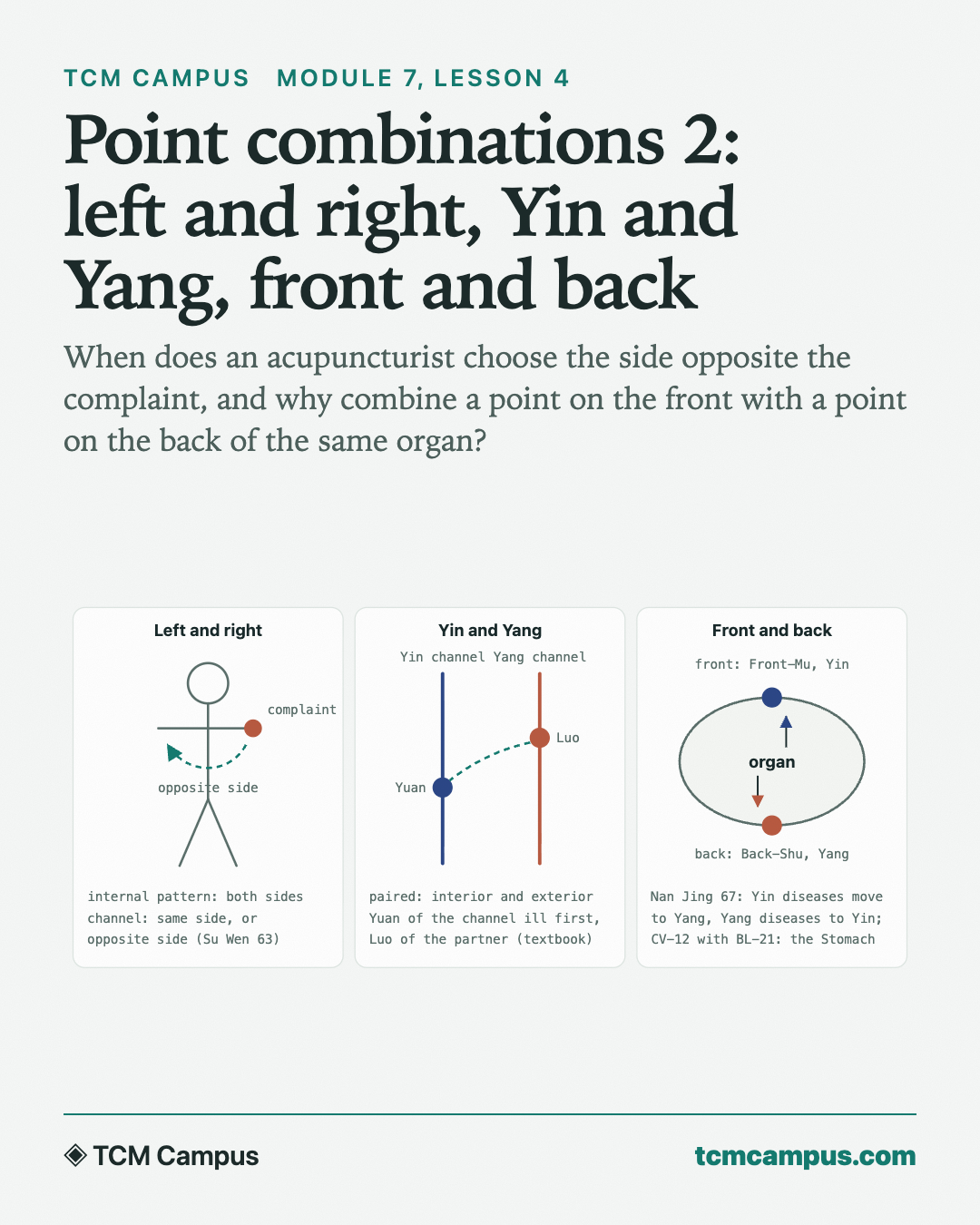
- Left and right. Internal patterns usually on both sides; channel complaints on the affected side, or precisely on the opposite side (textbook knowledge).
- Opposite side, Su Wen 63. Taking the left for the right and the right for the left: ju ci 巨刺 for the main channel, miu ci 缪刺 for the Luo vessels. Su Wen 5: whoever needles well treats the left via the right and the right via the left.
- Yin and Yang. The paired channel, interior and exterior: LR-3 with GB-34, LU-7 with LI-4. Su Wen 5: draw Yang from Yin and Yin from Yang.
- Yuan and Luo, host and guest (textbook knowledge). The Yuan point of the channel that fell ill first, with the Luo point of its partner: SP-3 with ST-40 when the Spleen comes first. mnemonic: the host gives its source, the guest brings the bridge.
- Front and back. Front-Mu (front, Yin) with Back-Shu (back, Yang) of the same organ: CV-12 with BL-21 (Stomach), LR-14 with BL-18 (Liver), LR-13 with BL-20 (Spleen). Nan Jing 67: Yin diseases move to the Yang, Yang diseases to the Yin.
- A tendency, not a rule (textbook knowledge). Back-Shu in chronic Deficiency and the Zang; Front-Mu in acute Excess and the Fu. Tenderness on either helps the diagnosis.
- Five balances. Distal and local, above and below, left and right, Yin and Yang, front and back. mnemonic: never build a set BADLY: Back-front, Above-below, Distal-local, Left-right, Yin-Yang.
The rest of this lesson is reference.
Three practice questions from this lesson
What does Su Wen 63 say?
- Take the left for the right, the right for the left
- Yin diseases move to the Yang, Yang diseases to the Yin
- Draw Yang from Yin and Yin from Yang
Answer: Take the left for the right, the right for the left. Su Wen 63, Miu Ci Lun: 以左取右,以右取左, needling the opposite side. Drawing Yang from Yin is Su Wen 5; the movement of Yin and Yang diseases is Nan Jing 67.
What is the difference between ju ci and miu ci?
- Ju ci on the main channel, miu ci on the Luo vessels
- Ju ci on the same side, miu ci on both sides
- Ju ci for the Luo vessels, miu ci for the main channel
Answer: Ju ci on the main channel, miu ci on the Luo vessels. Su Wen 63: if the pathogen is in the channel, ju ci on the channel; if it is in the Luo vessels, which spread from left to right, miu ci. Both are opposite-side needling.
Spleen-Qi deficiency: on which side do you usually choose the points?
- Only on the left
- Both sides
- Only on the right, the side of the Spleen pulse
Answer: Both sides. Textbook knowledge: internal patterns usually on the left and right.
The rest of this lesson
In the course you get the step-by-step explanation, 22 case-based practice questions, 14 spaced-repetition flashcards, the pitfalls and the bridge to physiology with evidence grades. This lesson belongs to module 7: Treatment.