All lessons Module 1: Foundations Lesson 15
Point categories and selection strategy
Why does an acupuncturist choose this point, with this technique, and not the point next to it?
The key question of lessons 14 to 17. After this lesson you can place every point in its category, you know what that category promises, and you keep pattern, channel and segment apart.
Know by heart
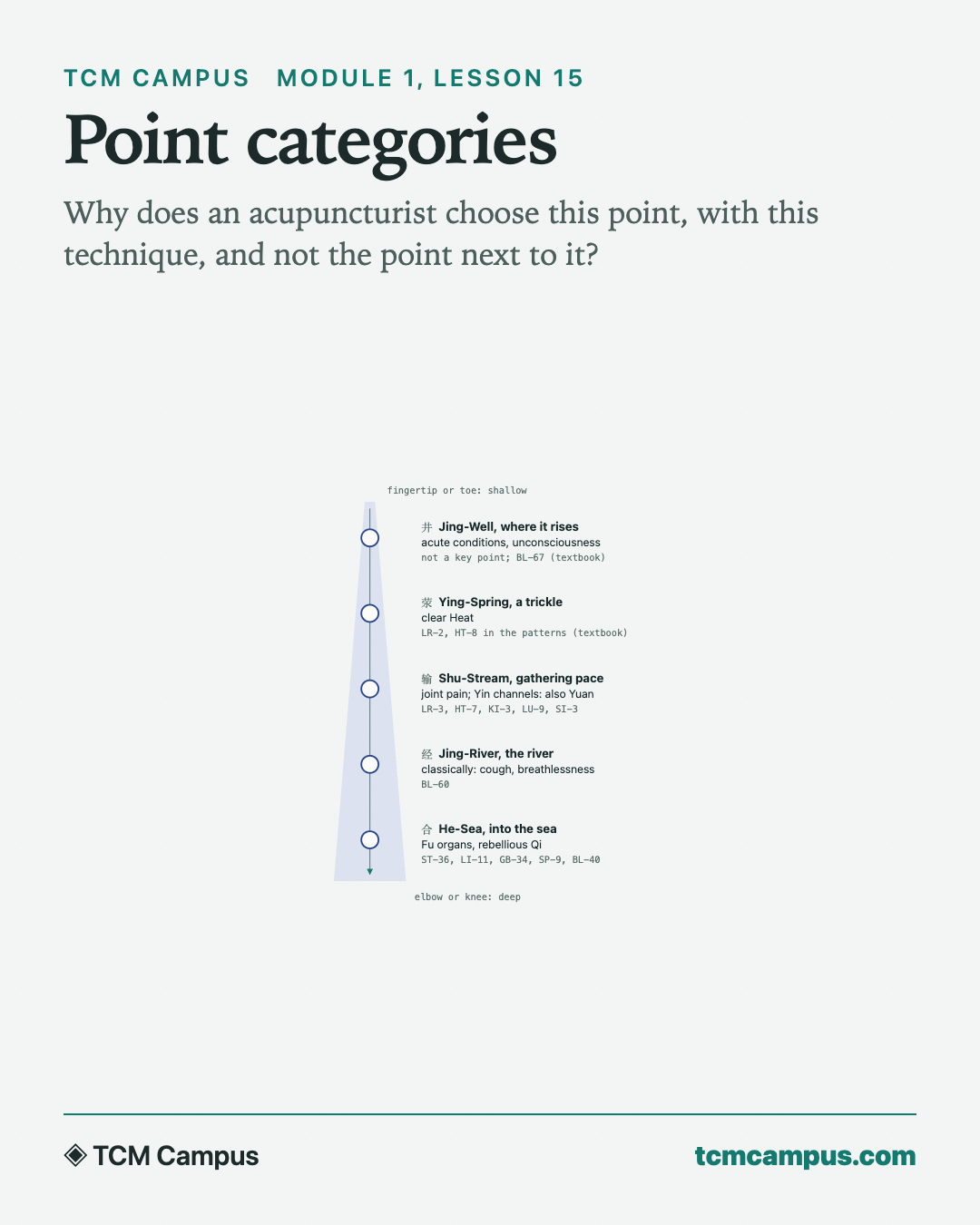
- Five Shu points. Jing-Well: acute conditions, unconsciousness. Ying-Spring: clear Heat. Shu-Stream: joint pain, on Yin channels also Yuan. Jing-River: classically cough, breathlessness, alternating chills and fever. He-Sea: Fu organs, rebellious Qi. mnemonic: well, spring, stream, river, sea; from nail to elbow, from shallow to deep.
- Yuan, Luo, Xi. Yuan: the Original Qi of the organ, tonify the Zang. Luo: connects with the partner, two channels at once. Xi: accumulation, acute pain, on Yin channels also bleeding. mnemonic: Yuan is the organ's own source, Luo links to the partner, Xi is the cleft where things get stuck.
- Back-Shu and Front-Mu. Back-Shu: one back point per organ, chronic Deficiency. Front-Mu: one point per organ on the chest or abdomen, acute Excess. mnemonic: what lies behind you is old (chronic and empty); what lies in front of you is now (acute and full).
- Eight Hui points. Blood BL-17; Qi CV-17; sinews GB-34; blood vessels LU-9; bones BL-11; Marrow GB-39; Zang LR-13; Fu CV-12. mnemonic: two CV (Qi 17, Fu 12), two BL (Blood 17, bones 11), two GB (sinews 34, Marrow 39), plus LU-9 and LR-13; 17 twice, Qi in front and Blood behind.
- Opening points, in pairs. SP-4 with PC-6; LU-7 with KI-6; SI-3 with BL-62; GB-41 with TE-5 (lesson 14).
- Four command points. ST-36 abdomen; BL-40 back; LU-7 head and neck; LI-4 face. mnemonic: from bottom to top, abdomen, back, head, face; the book names a fifth (p. 864).
- Four crossing points from the thirty key points. SP-6 the three leg Yin; GB-20 with Yang Wei and Yang Qiao; GV-14 all Yang; GV-20 the Du with the Yang channels.
The rest of this lesson is reference.
Three practice questions from this lesson
How does the Qi flow along the Five Shu points?
- from the trunk to the fingertips
- from elbow and knee to fingertip and toe
- from fingertip and toe to elbow and knee
Answer: from fingertip and toe to elbow and knee. From shallow to deep.
Which Shu point clears Heat?
- He-Sea
- Ying-Spring
- Jing-Well
Answer: Ying-Spring. Ying-Spring: clear Heat.
Acute unconsciousness.
- Shu-Stream
- Jing-River
- Jing-Well
Answer: Jing-Well. Jing-Well: acute conditions, unconsciousness.
The rest of this lesson
In the course you get the step-by-step explanation, 21 case-based practice questions, 35 spaced-repetition flashcards, the pitfalls and the bridge to physiology with evidence grades. This lesson belongs to module 1: Foundations.