All lessons Module 4: Diagnosis Lesson 9
Palpation, hearing and smelling
What do your hands, ears and nose tell you that the pulse and the tongue do not?
After this lesson you can palpate the skin, limbs, chest, abdomen and points with three fixed questions, read voice, breathing, cough and odour for Excess, Deficiency, Heat and Cold, link sound and odour to the five Zang, and recognise the findings that go to a doctor first.
Know by heart
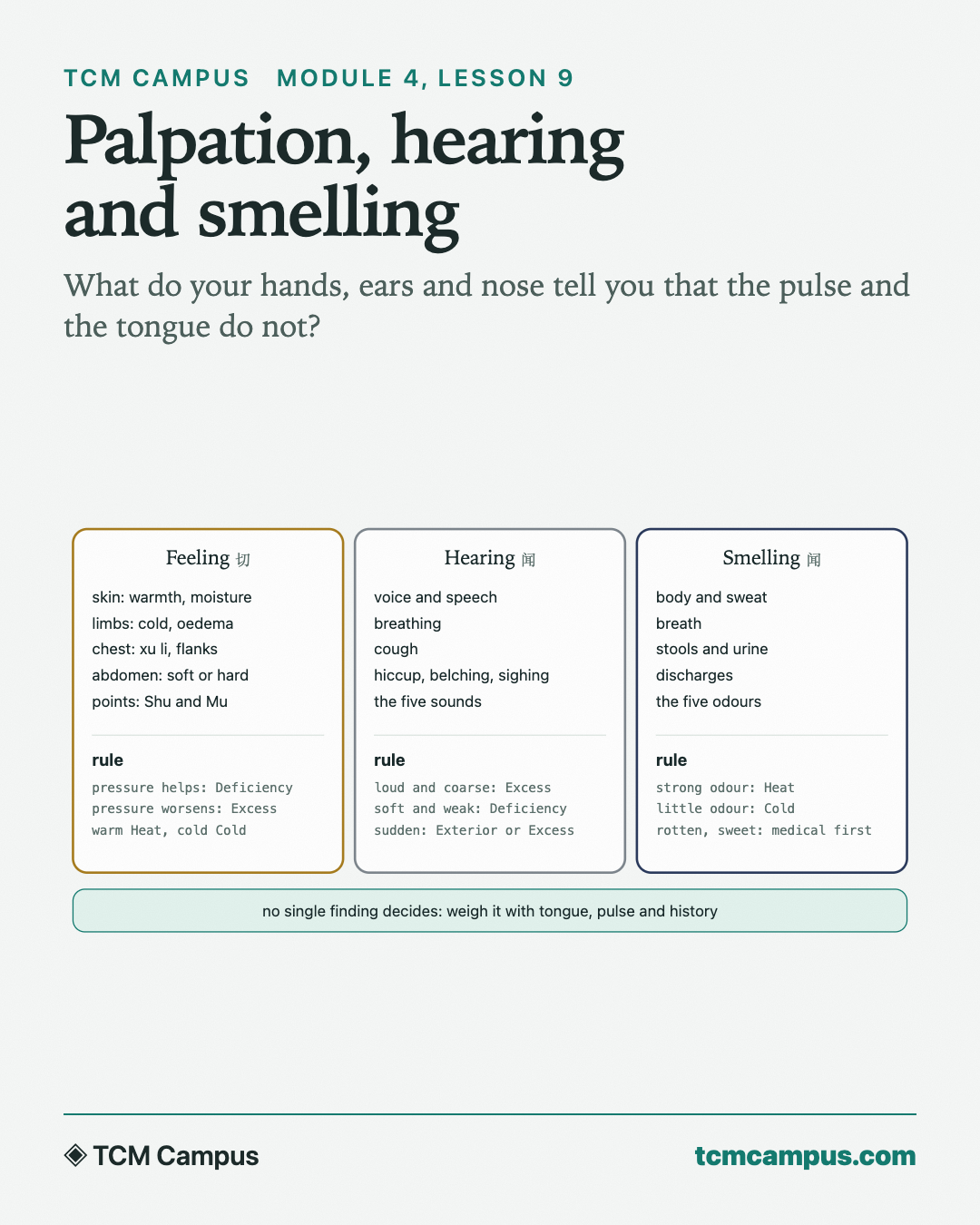
- Three rules. Pressure: better is Deficiency, worse is Excess. Warmth: warm is Heat, cold is Cold. Sound and odour: loud, coarse and strong is Excess or Heat; soft, weak and odourless is Deficiency or Cold; mnemonic: what pushes back is full, what gives way is empty.
- Skin and limbs. Back of the hand warmer: Exterior; palm warmer: Interior, often Yin deficiency. Everything cold: Yang deficiency; cold hands with a warm trunk: Qi stagnation. Oedema that pits: Water from Yang deficiency; without pitting: Qi stagnation (textbook knowledge).
- Chest. The Great Luo of the Stomach, xu li, below the left nipple: the beat of the Gathering Qi (Zong Qi) (Su Wen 18). Tension and pain below the ribs: Liver and Gall-Bladder.
- Abdomen and points. Soft, cool and better with pressure: Deficiency; hard, warm and worse with pressure: Excess. Ji is fixed (Blood), ju comes and goes (Qi). Tenderness at a Back-Shu or Front-Mu point points to its organ; mnemonic: ji is a building that stays, ju is a crowd that gathers and disperses.
- The five sounds. Shouting Liver, laughing Heart, singing Spleen, weeping Lungs, groaning Kidneys (Su Wen 5; Maciocia ch. 5 p. 103); mnemonic: the voice follows the emotion: anger shouts, joy laughs, pensiveness sings, sadness weeps, fear groans.
- The five odours. Rancid Liver, scorched Heart, fragrant Spleen, fishy Lungs, putrid Kidneys (Su Wen 4); mnemonic: from the forest (rancid wood) via the fire (scorched) and the bakery (fragrant) to the sea (fishy) and the swamp (putrid).
- Red flags. A pulsating mass in the abdomen, a hard abdomen with severe pain, a swollen warm leg on one side; breath that smells of acetone, urine or something sweet and musty; sudden slurred speech; coughing up blood: see a doctor first, some at once.
The rest of this lesson is reference.
Three practice questions from this lesson
Abdominal pain that eases when you lay a hand on it and press.
- Deficiency
- Excess
- Blood stasis
Answer: Deficiency. Better with pressure is Deficiency, worse with pressure is Excess. Blood stasis gives a fixed, stabbing pain that cannot bear pressure.
The back of the hand feels warmer than the palm, in someone who has been ill since yesterday.
- Exterior: a pathogen at the surface
- Yin deficiency: the palm is warmer
- Qi stagnation: cold hands, warm trunk
Answer: Exterior: a pathogen at the surface. Textbook knowledge: back of the hand warmer is Exterior, palm warmer is Interior, often Yin deficiency. Cold hands with a warm trunk fit Qi stagnation.
Cold hands and feet, but trunk and abdomen are warm; irritable, sighs a lot.
- Yang deficiency: the trunk is cold too
- Qi stagnation (pattern 1)
- Full-Cold that is stuck
Answer: Qi stagnation (pattern 1). In Yang deficiency trunk and abdomen are cold as well. Cold limbs with a warm trunk fit Qi stagnation: the Yang does not reach the limbs (textbook knowledge; pattern 1).
The rest of this lesson
In the course you get the step-by-step explanation, 15 case-based practice questions, 25 spaced-repetition flashcards, the pitfalls and the bridge to physiology with evidence grades. This lesson belongs to module 4: Diagnosis.