All lessons Module 8: Clinical practice Lesson 6
Pain and Bi syndromes
Where there is free flow, there is no pain: what blocks the flow, which pain belongs with a doctor first, and what is known about the effect?
After this lesson you can name the red flags in joint, muscle and back pain, read from the pain which pathogen or which deficiency blocks the flow, choose a principle for each type of Bi, and say for each pain indication how strong the evidence is. This material lies outside the Foundations: textbook knowledge, with PubMed.
Know by heart
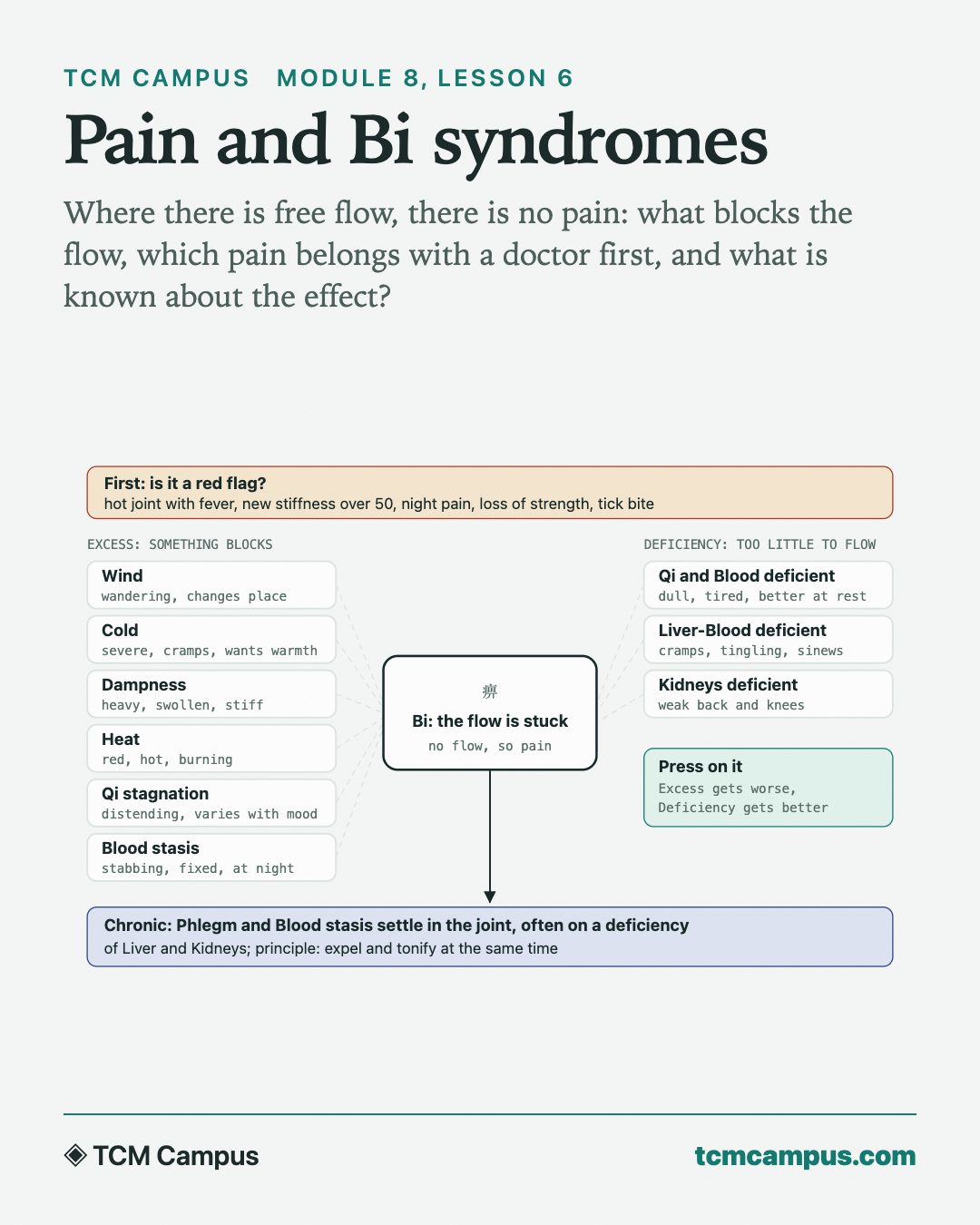
- Red flags in pain. Hot, swollen joint, especially with fever; new stiffness of shoulders and hips over the age of 50, with headache or jaw pain on chewing: the same day; morning stiffness for more than an hour in several joints; night pain with weight loss or a history of cancer; loss of strength or bladder problems with back pain; a growing red ring after a tick bite. mnemonic: hot, old, stiff, night, nerves, tick.
- Su Wen 43. Wind, Cold and Dampness come together and form Bi; when Wind predominates, the pain wanders; when Cold predominates, the pain is severe; when Dampness predominates, it is fixed. Heat-Bi is red and hot. mnemonic: Wind wanders, Cold clenches, Damp drags, Heat flares.
- Reading pain. Distending and changing: Qi stagnation; stabbing, fixed, at night: Blood stasis; a dull ache, better with rest: Deficiency; pulling, with cramps and tingling: Liver-Blood deficiency. mnemonic: press on Excess and it protests; press on Deficiency and it rests.
- Principle per type. Wind: expel Wind and nourish and move the Blood; Cold: warm, moxa; Dampness: resolve Dampness, tonify the Spleen; Heat: clear Heat; chronic: resolve Phlegm, move Blood, nourish Liver and Kidneys. mnemonic (textbook knowledge): to treat Wind, first treat the Blood.
- Formulas (textbook knowledge). Fang Feng Tang, Saposhnikovia Decoction (Wind); Wu Tou Tang, Aconite Decoction (Cold; aconite); Yi Yi Ren Tang, Coix Decoction (Dampness); Bai Hu Jia Gui Zhi Tang, White Tiger plus Cinnamon Twig Decoction (Heat); Shen Tong Zhu Yu Tang, Drive Out Stasis from a Painful Body Decoction (Blood stasis); Du Huo Ji Sheng Tang, Angelica Pubescens and Taxillus Decoction (chronic, with Liver and Kidney deficiency; contains Xi Xin).
- Points as study material. Local plus distal on the channel; GB-34 Hui of the sinews, BL-11 Hui of the bones, BL-17 Hui of Blood; BL-17 and SP-10 for Wind, moxa for Cold, ST-36 and SP-9 for Dampness, GV-14 and LI-11 for Heat.
- Evidence. Chronic pain: 0.5 SD against nothing, 0.2 against sham (class I); low back pain and knee osteoarthritis: against sham not clinically relevant (III); neck: briefly better than sham (I); fibromyalgia: not better than sham (III); sciatica: one positive trial (II). mnemonic: half against nothing, a fifth against sham.
The rest of this lesson is reference.
Three practice questions from this lesson
Case. Man, 58, wakes at night with a red, hot, swollen big toe; even the touch of the sheet hurts. No fever. What first?
- Clear Heat with GV-14 and LI-11 first, then wait a few days
- GP or primary care doctor within a week: no fever
- GP or primary care doctor the same day: gout or infection
Answer: GP or primary care doctor the same day: gout or infection. An acute hot joint is first a medical question, the same day: gout is most likely, septic arthritis has to be ruled out. Without fever it is still the same day; fever only makes it more urgent. In TCM language it is called Heat-Bi, but only after the doctor.
Case. Woman, 72: for three weeks stiff, painful shoulders and hips, especially in the morning, and since yesterday a headache at the temple and pain on chewing. What do you do?
- GP or primary care doctor the same day
- Treat Wind-Bi first; several joints are involved
- GP or primary care doctor within a week for the stiffness
Answer: GP or primary care doctor the same day. New stiffness of shoulders and hips over the age of 50 is PMR until proven otherwise; headache and jaw pain on chewing point to giant cell arteritis, with a risk of blindness. So the same day, not within a week.
What does Su Wen 43 say about the three pathogens of Bi?
- Wind: the pain wanders; Cold: severe pain; Dampness: it is fixed
- Wind: it is fixed; Cold: the pain wanders; Dampness: it burns
- Wind: severe pain; Cold: it is fixed; Dampness: the pain wanders about
Answer: Wind: the pain wanders; Cold: severe pain; Dampness: it is fixed. Wind, Cold and Dampness come together; the predominant one determines the type: wandering, painful, fixed. Burning, red and hot is Heat-Bi.
The rest of this lesson
In the course you get the step-by-step explanation, 14 case-based practice questions, 19 spaced-repetition flashcards, the pitfalls and the bridge to physiology with evidence grades. This lesson belongs to module 8: Clinical practice.