All lessons Module 8: Clinical practice Lesson 5
Menstruation and menopause
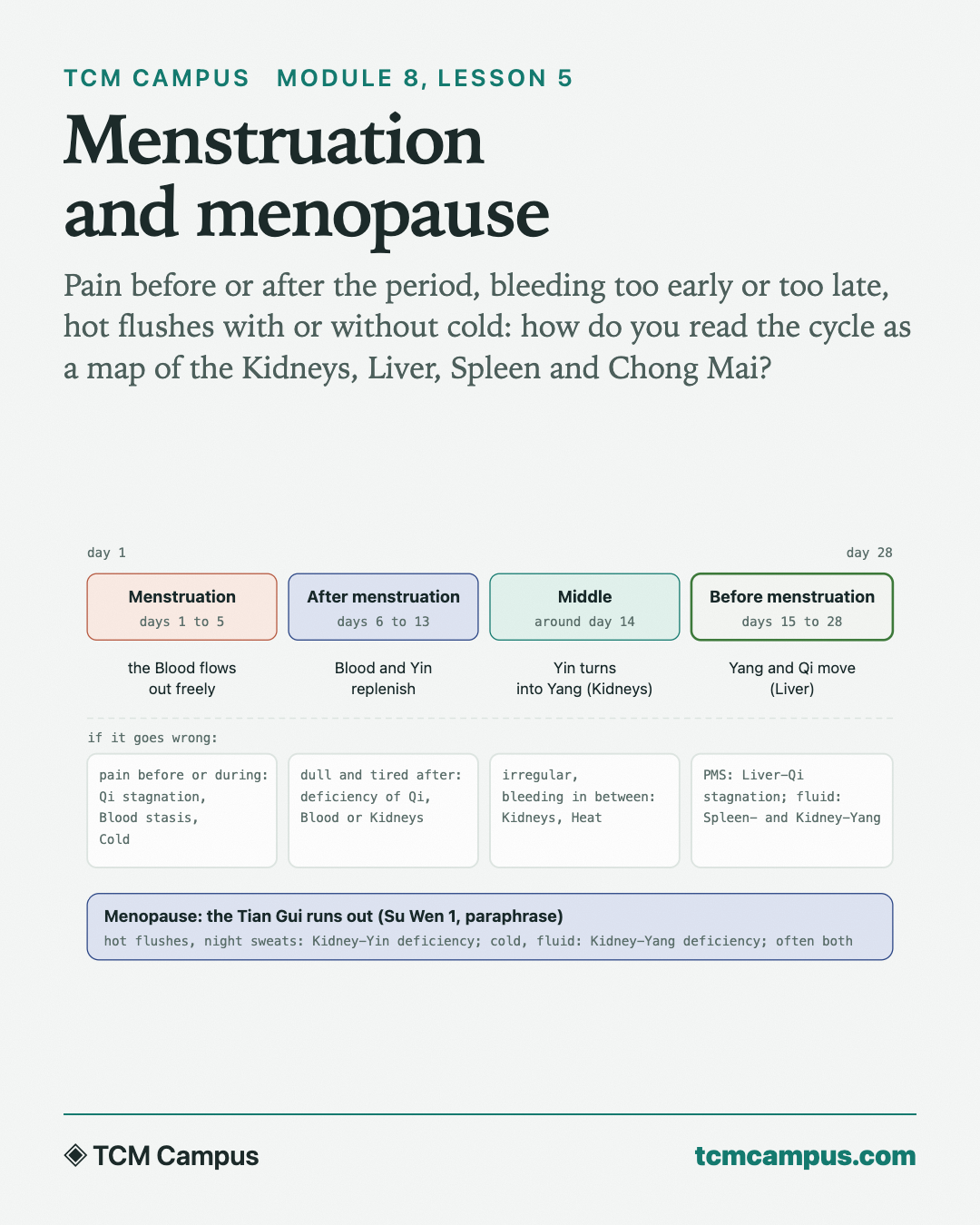
Pain before or after the period, bleeding too early or too late, hot flushes with or without cold: how do you read the cycle as a map of the Kidneys, Liver, Spleen and Chong Mai?
After this lesson you know the red flags in menstrual complaints and in the menopause, you can read pain, timing and amount as a pattern, you know the patterns of dysmenorrhoea, PMS, cycle disorders and menopause with tongue, pulse and principle, you can explain an example point selection, and you know what research on acupuncture and herbs shows here.
Know by heart
- Red flags. Bleeding after the menopause; acute one-sided abdominal pain with a positive test or a missed period; fever with abdominal pain and discharge; pain during sex or bowel movements and pain that increases over the years; very heavy periods with fatigue; bleeding after intercourse; periods stopping before the age of forty. mnemonic: the seven Ps: Postmenopausal bleeding, Pregnancy pain, Pelvic infection, Painful sex or stools, Pallor, Post-coital bleeding, Premature menopause.
- Reading pain. Before or during and worse with pressure: Excess; after and better with pressure: Deficiency; better with warmth: Cold; stabbing with clots: Blood stasis; tense and distended: Qi stagnation.
- Reading the cycle. Too early: Heat or Qi deficiency. Too late: Blood deficiency, Cold or stagnation. Too heavy: Heat, Qi deficiency (the Spleen does not hold) or stasis. Too scanty: Blood deficiency or Cold.
- The players. Kidneys: root and Tian Gui. Spleen: makes and holds. Liver: stores and lets flow. Chong Mai: Sea of Blood. mnemonic: Kidneys seed, Spleen feeds, Liver leads, Chong fills the sea.
- Menopause. Kidney-Yin deficiency: hot flushes, night sweats, red without coating. Kidney-Yang deficiency: feels the cold, fluid retention, pale and wet. Both: hot flushes and cold feet. Also: Heart and Kidneys (sleep), Liver-Yang (headache).
- Point selection. SP-6 (three leg Yin), SP-8 (Xi-Cleft point of the Spleen, acute pain), SP-10 (Blood), LR-3 (Qi), CV-4 (Kidneys, Blood); moxa for Cold. In pregnancy avoid LI-4, SP-6 and the lower abdomen.
- Evidence. Dysmenorrhoea: too little evidence (Cochrane), NSAIDs work. PMS: possibly better than sham, low certainty. Hot flushes: not better than sham (Ee 2016), better than waiting list (Avis 2016). PCOS: no more live births (Wu 2017).
The rest of this lesson is reference.
Three practice questions from this lesson
Case. A woman of 58, five years after her last period, has had some bleeding again for a week. What first?
- GP or primary care doctor, promptly
- Gui Pi Tang for the Spleen, see her again in a month
- Cool Heat in the Blood and wait a week
Answer: GP or primary care doctor, promptly. Bleeding after the menopause is endometrial cancer until proven otherwise: GP or primary care doctor, promptly. Waiting a week or a month with a TCM treatment delays that.
Case. A woman of 29, period six weeks late, sudden severe pain in the right lower abdomen, dizzy. What first?
- Moxa for Cold in the Uterus first, then wait
- The GP or primary care doctor the same day for a pregnancy test
- Emergency: possibly an ectopic pregnancy
Answer: Emergency: possibly an ectopic pregnancy. Acute one-sided abdominal pain with a missed period, with dizziness, is an emergency: think of an ectopic pregnancy. A test with the GP later that day is too slow, and moxa is out of the question here.
Case. A woman of 33: period pain that has been getting worse for years, pain during sex and with bowel movements during the period; she has been trying to get pregnant for a year. What do you think?
- Primary dysmenorrhoea: NSAIDs are enough, no referral
- Endometriosis: GP or primary care doctor and gynaecologist
- Qi and Blood deficiency: nourish Blood with Ba Zhen Tang
Answer: Endometriosis: GP or primary care doctor and gynaecologist. Increasing pain, dyspareunia, painful bowel movements and subfertility point to endometriosis. Primary dysmenorrhoea is a diagnosis when there is no cause in the pelvis; Qi and Blood deficiency gives a dull pain at the end, better with pressure. Blood stasis is then an interpretation alongside the diagnosis, not instead of it.
The rest of this lesson
In the course you get the step-by-step explanation, 15 case-based practice questions, 15 spaced-repetition flashcards, the pitfalls and the bridge to physiology with evidence grades. This lesson belongs to module 8: Clinical practice.