All lessons Module 8: Clinical practice Lesson 2
Insomnia and restlessness
Not falling asleep, not staying asleep, or never settling at all: what does the time of night tell you about the Shen?
After this lesson you know what has to be checked medically first in poor sleep, you can read insomnia by time of night, dreams and restlessness, you know the patterns with tongue, pulse and principle, you can explain an example point selection, and you know how acupuncture compares with sham and with cognitive behavioural therapy for insomnia (CBT-I).
Know by heart
- Medical first. Snoring with pauses in breathing and sleepiness during the day (apnoea); low mood or thoughts of death; needing less sleep without being tired (mania); restlessness, palpitations and weight loss (thyroid); restless legs; medication, alcohol, caffeine. mnemonic: the six Ss: Snoring, Sadness, Speeding, Shaking, Shins, Substances.
- CBT-I first. Chronic insomnia (three nights a week or more, for three months, with daytime symptoms): cognitive behavioural therapy is the first choice; acupuncture can be added, not used instead.
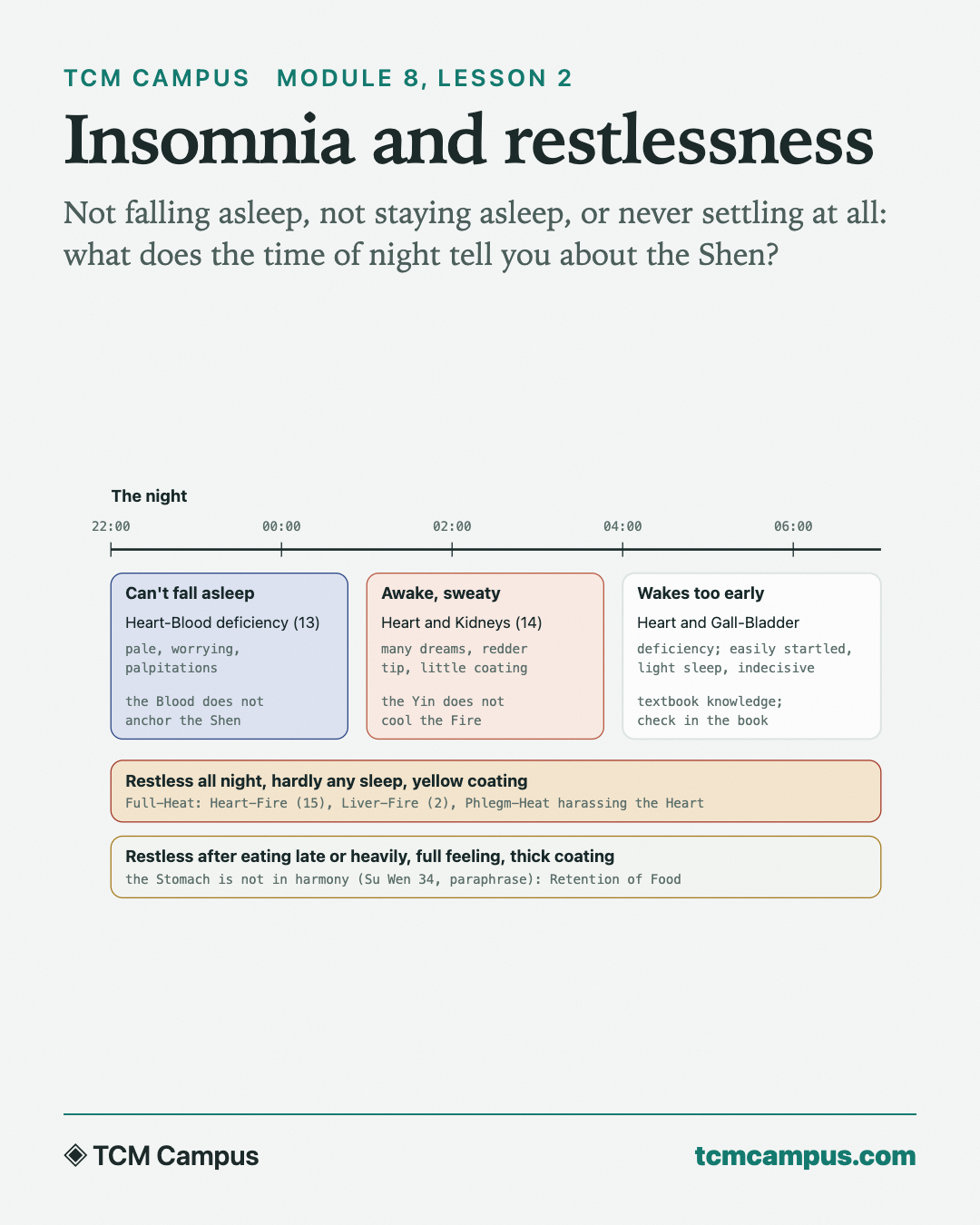
- The sleep triad. Falling asleep: Heart-Blood deficiency (13), pale and thin. Staying asleep, with dreams and night sweating: Heart and Kidneys (14), redder tip, little coating. Sleepless and restless: Heart-Fire (15), redder tip, yellow coating. mnemonic: Get, Stay, None; Pale, Bare, Yellow.
- Added from textbook knowledge. Waking early and easily startled: Heart and Gall-Bladder deficiency. Vivid dreams, irritable, bitter taste: Liver-Fire. Heavy, phlegm, restless: Phlegm-Heat (Wen Dan Tang). After eating late: the Stomach (Su Wen 34).
- Deficiency or Excess. Deficiency: creeping onset, light sleep, tired during the day, pale or little coating, weak or thin pulse. Excess: intense, restless, thirst or bitter taste, yellow or sticky coating, full rapid or slippery pulse.
- Point selection. Calm the Shen for everyone (HT-7, Yintang), nourish Yin and Blood (SP-6), plus the pattern points: KI-3 and KI-6 for 14, BL-15 and BL-20 for 13, LR-2 for Liver-Fire, ST-40 for Phlegm.
- Evidence. Cochrane 2012: too weak to support or refute. Newer sham trials positive (Yin 2017, Yin 2022). CBT-I did better than acupuncture, both clinically meaningful (Garland 2019).
The rest of this lesson is reference.
Three practice questions from this lesson
Case. A woman of 36 has slept only four hours a night for two weeks, feels 'fantastic', has lots of plans and talks fast. What first?
- The GP or primary care doctor the same day
- Clear Heart-Fire and see her again in a week
- First a sleep diary, then review in two weeks
Answer: The GP or primary care doctor the same day. Needing little sleep without being tired, with lots of plans and fast talking, is a red flag for (hypo)mania: the same day, as it may be mania. Waiting a week or two is too long. Only after that a TCM interpretation.
Case. A man of 58 sleeps badly, snores loudly, his partner sees pauses in breathing, and he falls asleep at the wheel during the day. What first?
- Treat Damp-Phlegm first with ST-40 and PC-6
- Ten sessions, then the GP or primary care doctor if no better
- Have sleep apnoea investigated; no driving for now
Answer: Have sleep apnoea investigated; no driving for now. Obstructive sleep apnoea comes first, and someone who nods off during the day does not drive as long as that lasts. Teeth marks on the tongue are associated with apnoea (Weiss 2005), but a pattern or a course of treatment does not replace a sleep study.
What is the first choice for chronic insomnia according to the guidelines?
- A sleeping pill for the first few weeks
- Cognitive behavioural therapy for insomnia (CBT-I)
- Acupuncture, with CBT-I added alongside it
Answer: Cognitive behavioural therapy for insomnia (CBT-I). CBT-I: twenty RCTs, falling asleep faster (19 minutes), less time awake (26 minutes), lasting (Trauer 2015). In Garland 2019 CBT-I did better than acupuncture. Acupuncture can go alongside, not instead; sleeping pills are tapered by the doctor.
The rest of this lesson
In the course you get the step-by-step explanation, 15 case-based practice questions, 15 spaced-repetition flashcards, the pitfalls and the bridge to physiology with evidence grades. This lesson belongs to module 8: Clinical practice.