All lessons Module 8: Clinical practice Lesson 8
Infections, Latent Heat and viral conditions
How does an acupuncturist read an infection that comes, lingers or returns later, and where does TCM stop and the doctor have to take over?
After this lesson you recognise the warning signs in infections, place a febrile illness on one of the Four Levels, explain Latent Heat and distinguish it from a residual pathogenic factor and from Shao Yang, reason about fatigue after a virus, and know for each indication how strong the evidence is. Latent Heat is in the Foundations; the rest is textbook knowledge, with PubMed.
An infection that needs antibiotics or antiviral drugs gets them first.
Know by heart
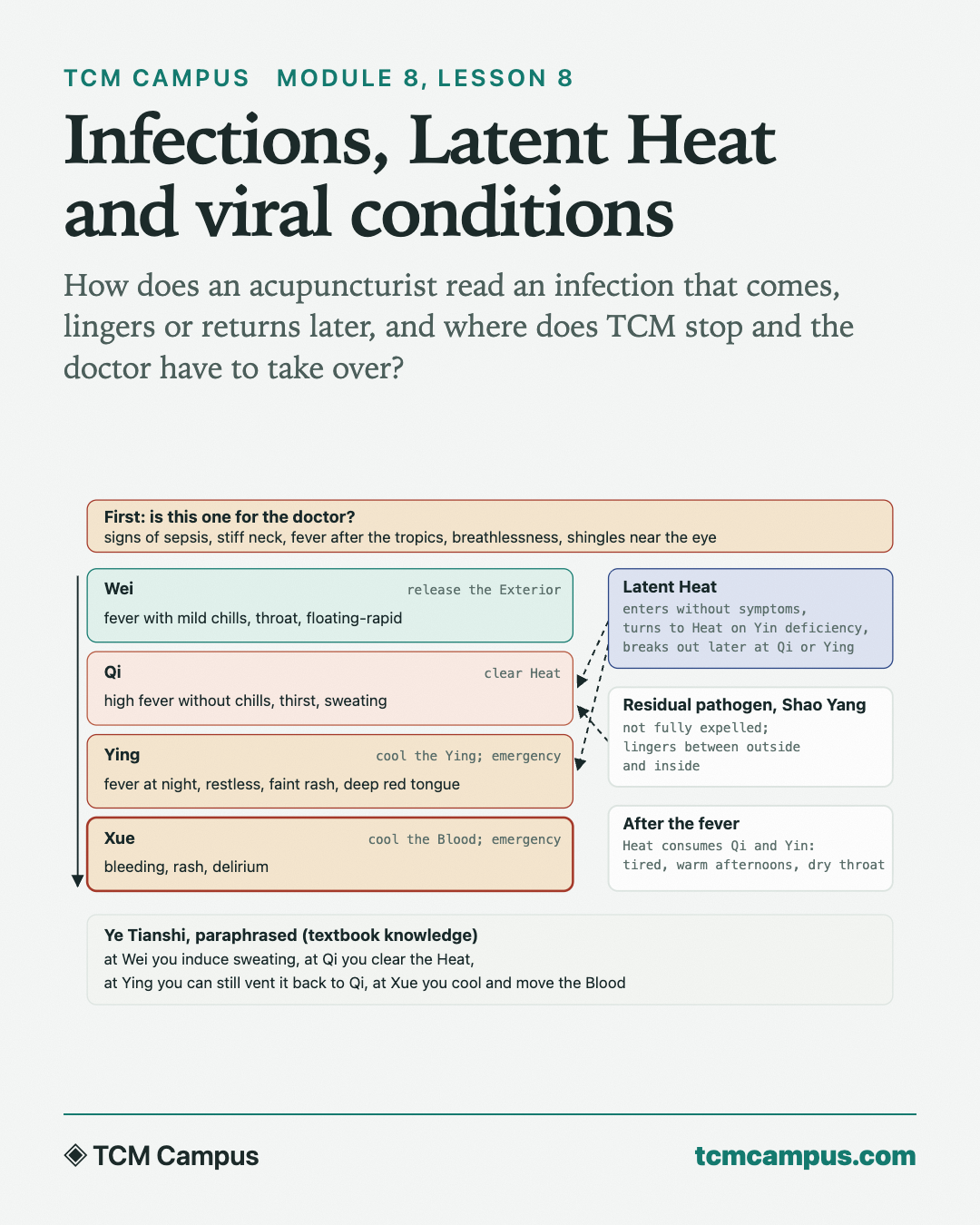
- Red flags in infection. Sepsis (drowsy or confused, rapid breathing, mottled skin, passing little urine), stiff neck or pinpoint bleeding spots, fever after the tropics, fever for more than three days or with an immune disorder, breathlessness, shingles near the eye. mnemonic: drowsy, rapid, stiff, tropics, eye.
- Medication first. A bacterial infection, Lyme disease with a red ring, shingles within 72 hours: antibiotics or antiviral drugs come first; herbs and needles alongside, never instead.
- Four Levels. Wei: fever with mild chills, throat, floating-rapid; Qi: high fever without chills, thirst, sweating; Ying: fever at night, restlessness, faint rash, deep red tongue without coating; Xue: bleeding, delirium. Ying and Xue are medical emergencies. mnemonic: from skin to Blood, from GP to hospital.
- Latent Heat (p. 779). A pathogen enters without symptoms, turns into Heat and breaks out later with interior Heat from the start, often triggered by a new invasion and on a Yin deficiency. Su Wen 5: whoever is injured by Cold in winter develops a Warm disease in spring; Su Wen 4: whoever stores their Jing in winter does not.
- Residual, latent or Shao Yang. Residual pathogenic factor: not fully expelled after an acute illness with symptoms; Latent Heat: entered without symptoms; Shao Yang: alternating chills and fever, bitter taste, fullness under the ribs, wiry: harmonise (Xiao Chai Hu Tang, Minor Bupleurum Decoction). mnemonic: residual stayed, latent slept, Shao Yang swings.
- After the fever. Heat consumes Qi and Yin: tired, warm in the afternoon, dry throat, red with little coating; nourish Qi and Yin (Sheng Mai San, Generating the Pulse Powder); do not tonify with the thief still inside; stimulate gently.
- Evidence. Flu: herbs shortened the fever as much as oseltamivir, unblinded (III); Andrographis in respiratory infections better than placebo, poor quality (II); recurrent cystitis: fewer recurrences, one small sham trial (II); shingles and long COVID: O.
The rest of this lesson is reference.
Three practice questions from this lesson
Case. Student, 19, high fever and headache since this morning; she cannot bend her head forward and has red spots on her legs that do not fade under pressure. What do you do?
- Yin Qiao San for the Wei level now, and call tomorrow
- Emergency services: possibly meningococcal sepsis
- GP or primary care doctor the same day
Answer: Emergency services: possibly meningococcal sepsis. Fever with a stiff neck and pinpoint bleeding spots that do not fade is meningococcal sepsis until proven otherwise: emergency services (112 in Europe, 999 in the UK, 911 in North America), not later that day. In Wen Bing language this is at Ying or Xue, and that is precisely why it belongs with the doctor.
Case. Man, 46, back from a trip to Ghana, fever with shaking chills and headache for two days. What first?
- Wind-Cold first: release the Exterior
- Harmonise Shao Yang, the doctor within a week
- To the doctor the same day: rule out malaria
Answer: To the doctor the same day: rule out malaria. Fever after the tropics is malaria until proven otherwise: the same day. The swinging picture resembles Shao Yang, but the trip decides; waiting a week is too long.
Case. Woman, 70, with a painful red rash in a band on one side of the forehead, reaching the tip of the nose. What first?
- Clear Damp-Heat in the Gall-Bladder first, then wait
- GP or primary care doctor within 72 hours for antivirals
- GP or primary care doctor the same day: shingles near the eye
Answer: GP or primary care doctor the same day: shingles near the eye. Shingles reaching the tip of the nose can affect the eye: then the same day, not within 72 hours as elsewhere on the body. Antiviral drugs work best within 72 hours; acupuncture belongs alongside at most.
The rest of this lesson
In the course you get the step-by-step explanation, 15 case-based practice questions, 16 spaced-repetition flashcards, the pitfalls and the bridge to physiology with evidence grades. This lesson belongs to module 8: Clinical practice.