All lessons Module 1: Foundations Lesson 1
How TCM thinks
Why do two people with the same diagnosis get a different treatment in Chinese medicine?
After this lesson you can explain why TCM treats a pattern rather than a disease label, read Yin and Yang as a relationship with four aspects, follow the four steps from complaint to principle in a case, and tell which tradition a practitioner reasons from.
Know by heart
- Bian Zheng Lun Zhi. findings, pattern, principle, methods; the methods follow from the principle, not from the complaint; mnemonic: first see, then name, then choose, then do.
- Bian Bing versus Bian Zheng. disease versus pattern; one disease, several patterns; one pattern, several diseases; mnemonic: Bing is the disease label, Zheng the pattern.
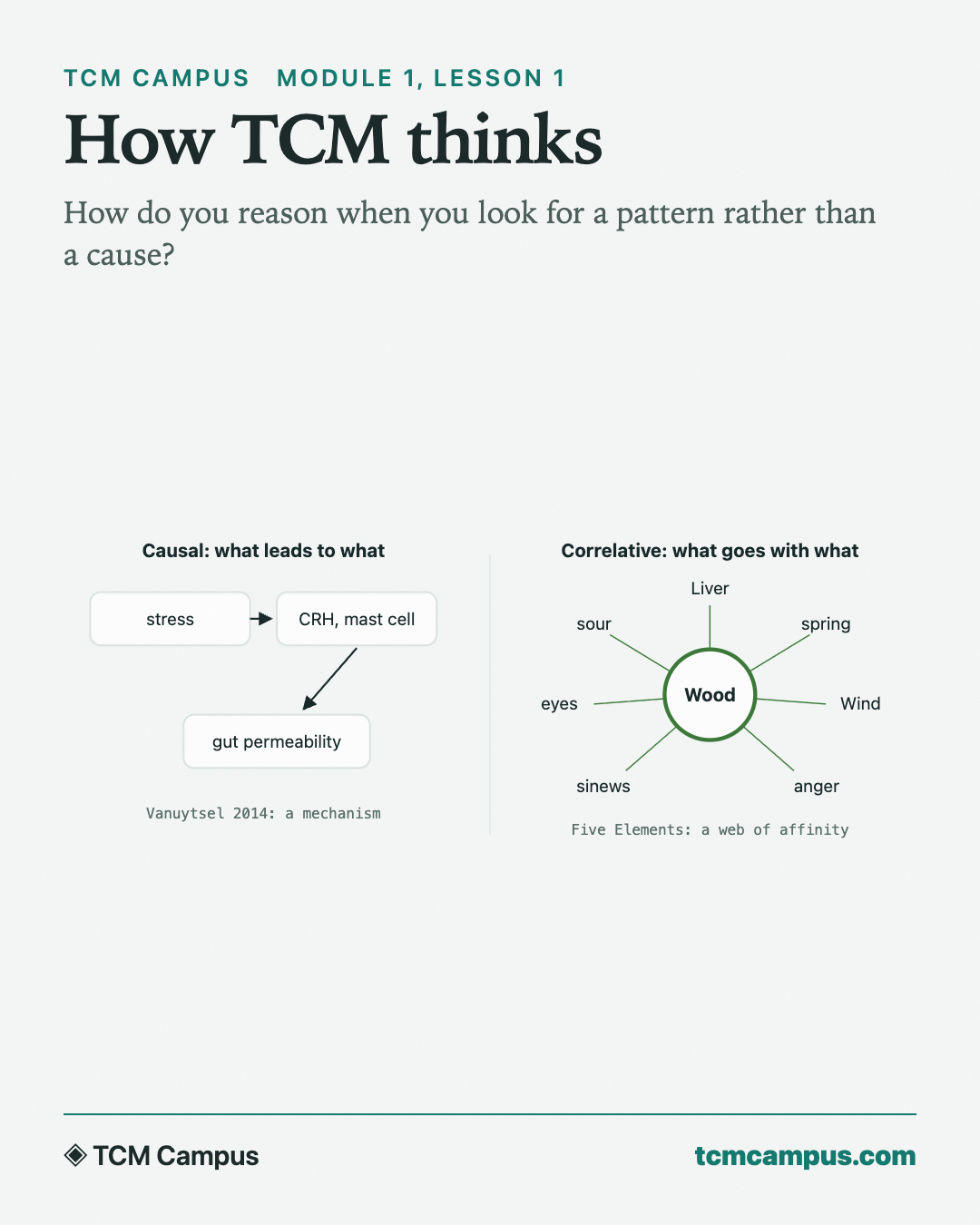
- The Liver is not the liver. a functional network, hence the capital letter; correlative thinking: what goes with what.
- Four Yin-Yang relationships. opposition, interdependence, mutual consumption, inter-transformation; always relative: Yin compared with what?; mnemonic: two poles that check each other, need each other, use each other up and flip at the extreme.
- Consumption versus transformation. consumption shifts gradually and both poles remain; transformation is the flip at the extreme.
- Four anchors. Huangdi Neijing (classical foundation), Shang Han Lun (around AD 200, Cold), Wen Bing school (17th and 18th centuries, Heat), "TCM" (1950s, People's Republic); mnemonic: Han is cold, Wen is warm, TCM is the youngest.
- Five traditions and a neighbour. TCM following Maciocia, Five Element, Japanese, Master Tung, classical (Shang Han Lun); alongside them dry needling, not a TCM tradition; mnemonic: five Ps and a neighbour: Pattern, Phase, Palpation, Point system, Prescription, and next door Pinpoint needling without theory.
The rest of this lesson is reference.
Three practice questions from this lesson
What does a pattern (zheng) describe?
- The name of the disease the doctor gives
- The picture of the whole person now
- The organ that is anatomically diseased
Answer: The picture of the whole person now. A pattern is the coherent picture of all the findings in one person at one moment. The disease label is bing; and the Liver is not the liver.
Two patients with IBS receive different treatments.
- Chance
- Bian Bing versus Bian Zheng
- A mistake: IBS calls for one treatment
Answer: Bian Bing versus Bian Zheng. One disease can show different patterns; what gets treated is the pattern. So the same disease does not get the same treatment in everyone.
Where do the points and herbs follow from?
- From the disease label
- From the worst complaint
- From the principle
Answer: From the principle. Findings, pattern, principle, methods. A 'point for IBS' skips the pattern and the principle; that is why patients A and B get something different.
The rest of this lesson
In the course you get the step-by-step explanation, 20 case-based practice questions, 30 spaced-repetition flashcards, the pitfalls and the bridge to physiology with evidence grades. This lesson belongs to module 1: Foundations.