All lessons Module 5: Patterns Lesson 5
Heart and Pericardium: all patterns
Palpitations, a tight chest, poor sleep: which Heart or Pericardium pattern is it, and which finding decides?
After this lesson you know the Heart patterns of ch. 32 as deficiency, excess, mixed and combined, with signs, tongue, pulse, cause and principle; you see where patterns 13, 14 and 15 from module 1 sit in that field; and you can read the Pericardium in its three faces from ch. 33. The features are learning anchors, not validated criteria.
Know by heart
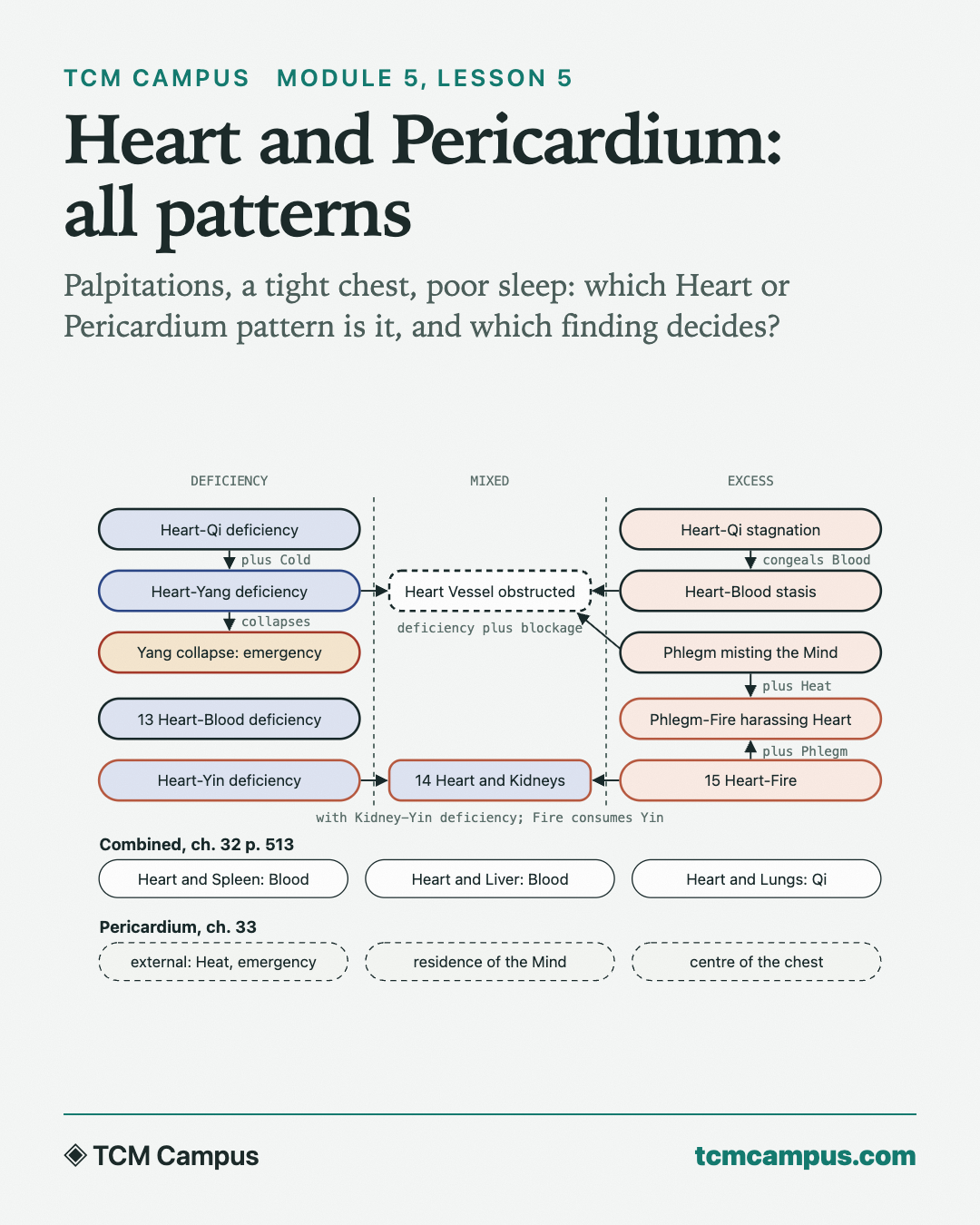
- The ladder of deficiency. Heart-Qi deficiency: palpitations, short of breath, daytime sweating; pale; empty. Heart-Yang deficiency: add cold; pale, wet, swollen; deep, weak. Heart-Yang collapse: cold sweat, icy limbs, pulse barely perceptible (minute): emergency services (112 in Europe, 999 in the UK, 911 in North America). mnemonic: Qi; add cold and it is Yang; add cold sweat and it is collapse.
- Blood or Yin. 13 Heart-Blood deficiency: cannot fall asleep, forgetful; pale and thin; choppy or thin; nourish Heart-Blood, calm the Mind. Heart-Yin deficiency: wakes in the night, night sweats, restlessness; red without coating, redder tip; thin-rapid; nourish Heart-Yin. With Kidney signs it is 14. mnemonic: pale lies awake, red wakes up.
- Fire and Phlegm. 15 Heart-Fire: tongue ulcers, thirst; redder tip, yellow coating; rapid, overflowing at Cun; clear. Phlegm-Fire: add confusion or agitation; sticky yellow coating; slippery-rapid. Phlegm misting the Mind: drowsy, confused, rattling throat; thick sticky white coating; slippery; resolve Phlegm, open the orifices. mnemonic: Fire races, Phlegm-Fire rages, Phlegm mists.
- Standstill in the chest. Heart-Qi stagnation: tight chest, sighing, low mood, after grief. Heart-Blood stasis: stabbing pain that radiates, purple lips; tongue purple; choppy or knotted; move Blood. Heart Vessel obstructed: deficiency with a blockage of Blood stasis, Phlegm, Cold or Qi. mnemonic: first the Qi knots, then the Blood clots.
- Combined patterns, p. 513. 14 Heart and Kidneys (Empty-Heat); Heart and Spleen (Blood, the Gui Pi picture); Heart and Liver (Blood); Heart and Lungs (Qi). mnemonic: the neighbour decides what falls short.
- Pericardium, three faces (ch. 33). External: Heat invades the Pericardium, with high fever, delirium and a deep-red tongue; residence of the Mind; centre of the chest. mnemonic: fever, mind, chest.
- Red flag. Chest pain, cold sweat with a weak pulse, sudden confusion, or confusion with fever: emergency services, before any pattern.
The rest of this lesson is reference.
Three practice questions from this lesson
Case. Woman, 48: palpitations, short of breath on the stairs, sweats in the daytime with little exertion, tired. Does not feel the cold. Tongue pale, normal shape; pulse empty.
- Heart-Yang deficiency
- Heart-Qi deficiency
- 13 Heart-Blood deficiency
Answer: Heart-Qi deficiency. Breathlessness and daytime sweating are the pump: Qi. Without cold and without a wet tongue, no Yang deficiency; without a thin tongue and without sleep and memory complaints, not 13. First: Hb, TSH, and an ECG if the palpitations are irregular.
Case. Like the previous one, but she always feels cold and has cold hands and a bright-white complexion. Tongue pale, wet, swollen; pulse deep and weak.
- Heart-Qi deficiency
- 12 Kidney-Yang deficiency
- Heart-Yang deficiency
Answer: Heart-Yang deficiency. Heart-Qi deficiency plus cold and a wet tongue: Heart-Yang deficiency. You choose 12 with a cold lower back, nocturia and clear urine, without palpitations.
Case. A man of 70 collapses in the waiting room: grey, cold sweat on the forehead, icy hands, pulse barely perceptible. What do you do?
- Emergency services; resuscitate if not breathing normally
- Look at the tongue and pulse first, then decide
- Warm Heart-Yang first, then emergency services
Answer: Emergency services; resuscitate if not breathing normally. In the language of the book, Heart-Yang collapse; in reality shock or cardiac arrest. The book describes the picture; in practice you call emergency services straight away: every minute spent on something else first is lost.
The rest of this lesson
In the course you get the step-by-step explanation, 14 case-based practice questions, 22 spaced-repetition flashcards, the pitfalls and the bridge to physiology with evidence grades. This lesson belongs to module 5: Patterns.