All lessons Module 8: Clinical practice Lesson 1
Headache and migraine
Where is the pain, what does it feel like and what makes it worse: how do three questions turn one headache into a pattern?
After this lesson you know the red flags and the medical types of headache, you can read a headache by site, character and course, you can set the patterns side by side with tongue, pulse and principle, you can explain an example point selection, and you know what research on acupuncture in migraine and tension-type headache does and does not show.
Know by heart
- Red flags first. Sudden and severe (thunderclap); new or changed, especially after the age of fifty; neurological deficit or confusion; fever with neck stiffness; worse lying down, coughing or straining, with vomiting in the morning; pregnancy, cancer or reduced immunity; after a fall. mnemonic: the five Ss: Sudden, Shifted, Signs, Sick, Strain.
- Medication overuse. Painkillers on 15 days or more a month, or triptans or combination drugs on 10 days or more: that keeps the headache going by itself; first the GP or primary care doctor.
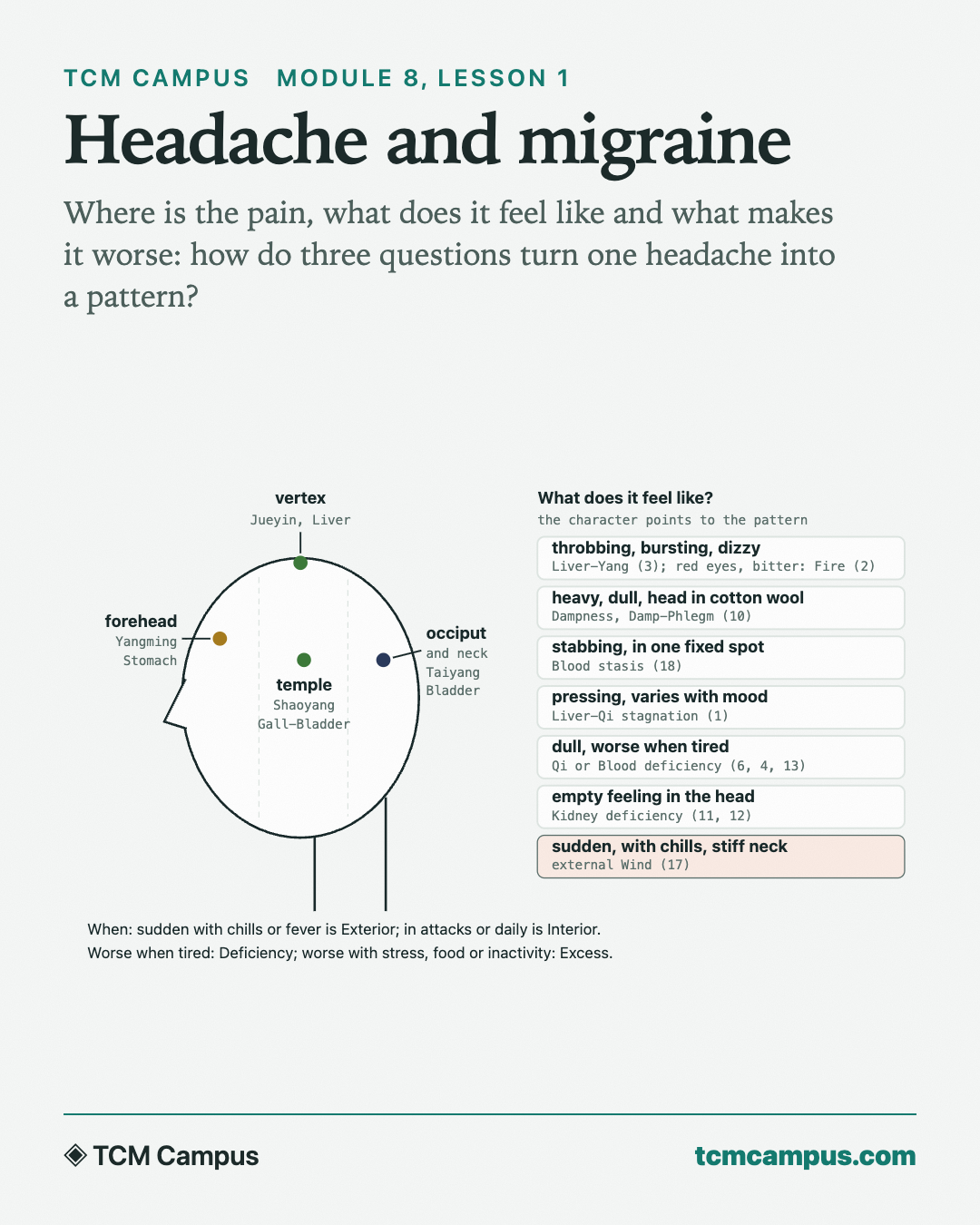
- The site is the channel. Forehead Yangming (Stomach); temple Shaoyang (Gall-Bladder); occiput and neck Taiyang (Bladder); vertex Jueyin (Liver). mnemonic: as on the trunk: Stomach channel in front, Gall-Bladder channel at the side, Bladder channel at the back; the Liver climbs all the way to the top.
- The character is the pattern. Throbbing Liver-Yang; heavy Dampness or Phlegm; stabbing Blood stasis; pressing and varying Liver-Qi; dull and better with rest Deficiency; an empty head the Kidneys.
- Exterior or Interior, Deficiency or Excess. Sudden with chills and a floating pulse: external Wind, release the Exterior first. Worse when tired, better with rest: Deficiency; worse with stress, alcohol or fatty food: Excess.
- Point selection: pattern plus site. Pattern points (LR-3 and KI-3 for Liver-Yang on Yin deficiency) plus a distal point on the channel of the site and a local point; GB-20 and LR-3 is the classic pair of local and distal.
- Evidence. Migraine: against no acupuncture 41 versus 17 per cent responders (NNT 4), against sham 50 versus 41 (NNT 11). Tension-type headache: against sham 51 versus 43. The sham trials vary: look at what the control group received.
The rest of this lesson is reference.
Three practice questions from this lesson
Case. A man of 52 gets the worst headache of his life within a few seconds while exercising. What do you do?
- LR-3 and GB-20 for Liver-Yang now, then wait
- To the GP or primary care doctor the same day
- Emergency services or the emergency department
Answer: Emergency services or the emergency department. Thunderclap headache: a headache that peaks within a minute is a subarachnoid haemorrhage until proven otherwise. Call emergency services (112 in Europe, 999 in the UK, 911 in North America); the GP later that day is too slow. No pattern, no point.
Case. A woman of 71 has had a new headache at the temple for three weeks; chewing hurts and now and then her vision is blurred. What is this first?
- Shaoyang headache with Liver-Fire: clear the Fire first
- Tension-type headache: GP or primary care doctor within a week
- Possibly temporal arteritis: to the doctor the same day
Answer: Possibly temporal arteritis: to the doctor the same day. New headache after fifty, jaw pain on chewing and visual symptoms: temporal arteritis can lead to blindness, so the same day. That the pain sits on Shaoyang changes nothing about that. Tension-type headache is two-sided and gives no pain on chewing or visual symptoms; waiting a week is too late here.
Case. A man of 45 has a headache almost every day and takes paracetamol (acetaminophen) on 18 days a month. What do you recognise first?
- Blood deficiency: dull and there every day, so nourish Blood first
- Nothing special; paracetamol is harmless
- Possibly medication overuse; first the GP or primary care doctor
Answer: Possibly medication overuse; first the GP or primary care doctor. Simple painkillers on 15 days or more a month, triptans or combination drugs on 10 or more (ICHD-3): the medication keeps the headache going. Tapering and prophylaxis are arranged by the doctor. A pattern may play a part, but the medication question comes first.
The rest of this lesson
In the course you get the step-by-step explanation, 16 case-based practice questions, 15 spaced-repetition flashcards, the pitfalls and the bridge to physiology with evidence grades. This lesson belongs to module 8: Clinical practice.