All lessons Module 7: Treatment Lesson 9
Formulas and herbal safety
How do you read a formula as a treatment plan, and how do you know whether it is safe for this client?
After this lesson you know twelve formula families with their main formulas (name, principle, broad composition, when not to use them), you know which formulas contain the high-risk herbs, and you can assess interactions, liver and kidney risk, contamination and pregnancy for each client, with the source to hand.
Know by heart
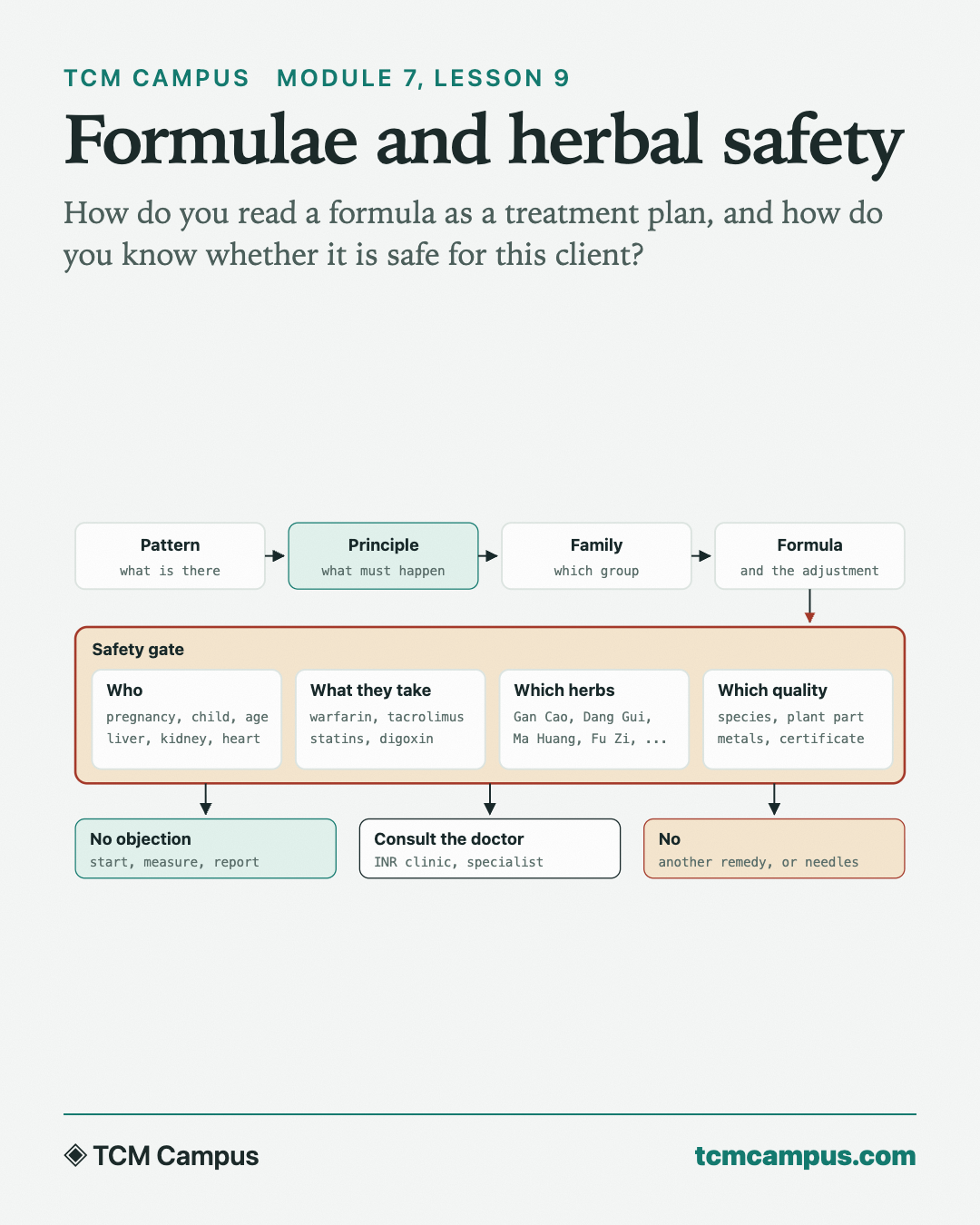
- A formula is a treatment plan. The principle picks the family, the pattern the formula, the accompanying signs the adjustment; emperor, minister, assistant, envoy (module 1, lesson 17). mnemonic: family, formula, fine-tuning.
- Four questions at the gate. Who (pregnancy, child, older person, liver, kidney, heart)? What do they take? Which high-risk herbs are in it? Which quality? mnemonic: who, what, which, where from.
- Interactions: level or effect. Level: berberine (CYP), baicalin (OATP1B1), Wuzhi capsules (tacrolimus up). Effect: Dan Shen, Dang Gui and Gou Qi Zi with warfarin; Ma Huang with stimulants; Gan Cao with diuretics.
- Liver. He Shou Wu (more often with HLA-B*35:01), Bai Xian Pi, Huang Yao Zi, and Tu San Qi as a mix-up with pyrrolizidine alkaloids; liver tests at the start and after four weeks. mnemonic: hair, skin, tuber, fake.
- Kidney and cancer. Aristolochic acid in Guang Fang Ji, Guan Mu Tong, Ma Dou Ling, Qing Mu Xiang, and in the aerial parts of Xi Xin: kidney fibrosis, urothelial cancer, also liver cancer. mnemonic: two names, one poison (Fang Ji, Mu Tong).
- Metals and adulteration. Zhu Sha (mercury) and Xiong Huang (arsenic) as deliberate ingredients; undeclared drugs and species. Demand a certificate of analysis for each batch, the Latin name and the plant part.
- Pregnancy. No Blood-moving, strongly purging or toxic herbs (textbook knowledge); a lot of liquorice is associated with adverse outcomes in the child; no berberine in newborns. mnemonic: no moving, no purging, no poison.
The rest of this lesson is reference.
Three practice questions from this lesson
Which family and formula belong to Wind-Cold without sweating?
- Clear Heat: Bai Hu Tang
- Release: Ma Huang Tang
- Consolidate: Yu Ping Feng San
Answer: Release: Ma Huang Tang. Release with pungent-warm herbs. Watch out for Ma Huang with high blood pressure, heart disease and pregnancy.
Why does Yu Ping Feng San not belong in the middle of a cold?
- It is a purging formula that exhausts
- It contains Ma Huang, which raises blood pressure
- Consolidating shuts the thief inside
Answer: Consolidating shuts the thief inside. Yu Ping Feng San (Huang Qi, Bai Zhu, Fang Feng) is in the consolidating family: it closes the door with the thief inside. Between colds, not during one. It contains no Ma Huang, and it does not purge.
Which formula contains both cinnabar and realgar?
- Liu Wei Di Huang Wan
- Si Jun Zi Tang
- An Gong Niu Huang Wan
Answer: An Gong Niu Huang Wan. Mercury and arsenic as deliberate ingredients; in China an emergency remedy for Heat in the Pericardium (Liu 2008).
The rest of this lesson
In the course you get the step-by-step explanation, 17 case-based practice questions, 22 spaced-repetition flashcards, the pitfalls and the bridge to physiology with evidence grades. This lesson belongs to module 7: Treatment.