All lessons Module 6: Points Lesson 3
The Eight Extraordinary Vessels
When does an acupuncturist choose an extraordinary vessel instead of an ordinary channel, and what do they gain by it?
After this lesson you know the eight vessels with their opening point and coupled point, you can name their functions and the axes along which they work, you recognise the classical disease picture of each vessel, and you know when a practitioner chooses a vessel.
Know by heart
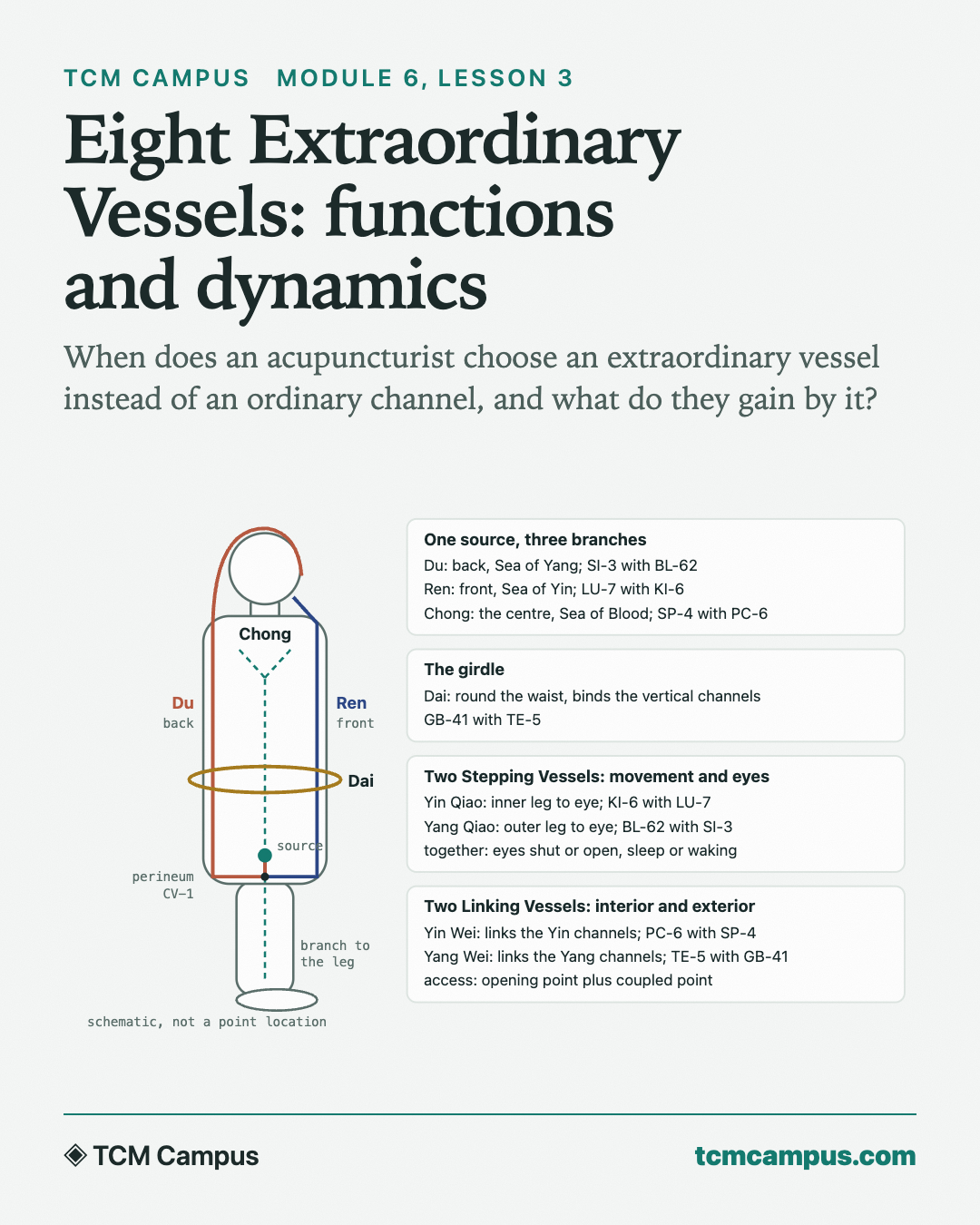
- Four pairs. Du SI-3 with BL-62 (Yang Qiao); Ren LU-7 with KI-6 (Yin Qiao); Chong SP-4 with PC-6 (Yin Wei); Dai GB-41 with TE-5 (Yang Wei). mnemonic: each pair is one arm point and one leg point; the Yang pairs share a level (Taiyang, Shaoyang), the Yin pairs do not.
- Rivers and lakes. The twelve channels are rivers, the eight vessels lakes that absorb excess and make up for shortfall. Only the Ren and Du have points of their own; the other six cross points of the twelve.
- One source, three branches. Du, Ren and Chong arise in the lower abdomen, between the Kidneys, and emerge together at the perineum (CV-1): Du at the back, Sea of Yang; Ren at the front, Sea of Yin; Chong through the centre, Sea of Blood.
- The other five. Dai: a girdle around the waist. Yin and Yang Qiao: from heel to eye, inner side and outer side, eyes shut and open. Yin and Yang Wei: link the Yin channels (interior) and the Yang channels (exterior). mnemonic: girdle, heel, net.
- Nan Jing 29 in one line. Du stiff spine; Ren knots in the abdomen; Chong rebellious Qi with cramp; Dai full abdomen, waist as if sitting in water; Yin Qiao inner side tight; Yang Qiao outer side tight; Yin Wei heart pain; Yang Wei chills and fever. mnemonic: spine, knots, rising, water; inside, outside; heart, fever.
- Seven and eight (Su Wen 1). In a woman at fourteen the Ren opens and the Chong is full: menstruation begins; at forty-nine the Ren is empty and the Chong weakened. For a man the text counts in steps of eight.
- When a vessel. A picture that spans several channels at once; constitution, Jing and the Kidneys; menstruation, pregnancy and menopause; a clear direction (front or back, interior or exterior, inner or outer side). Otherwise the channel.
The rest of this lesson is reference.
Three practice questions from this lesson
Which point opens the Chong Mai?
- KI-6
- SP-4
- PC-6
Answer: SP-4. SP-4 opens the Chong; PC-6 is the coupled point and itself opens the Yin Wei. KI-6 opens the Yin Qiao.
Which vessel does TE-5 open?
- Dai Mai
- Yang Qiao
- Yang Wei
Answer: Yang Wei. TE-5 opens the Yang Wei; its partner GB-41 opens the Dai.
Which two points form a pair?
- SI-3 and KI-6
- GB-41 and BL-62
- SI-3 and BL-62
Answer: SI-3 and BL-62. SI-3 (Du) with BL-62 (Yang Qiao): both Taiyang, hand and foot. KI-6 goes with LU-7, GB-41 with TE-5.
The rest of this lesson
In the course you get the step-by-step explanation, 16 case-based practice questions, 28 spaced-repetition flashcards, the pitfalls and the bridge to physiology with evidence grades. This lesson belongs to module 6: Points.