All lessons Module 1: Foundations Lesson 14
Channels, Extraordinary Vessels and the Six Stages
Which six level pairs exist, and why does that matter for the Six Stages?
After this lesson you can draw the circle of twelve, name the level, partner and namesake of each channel, read three code systems and know the opening pairs.
Know by heart
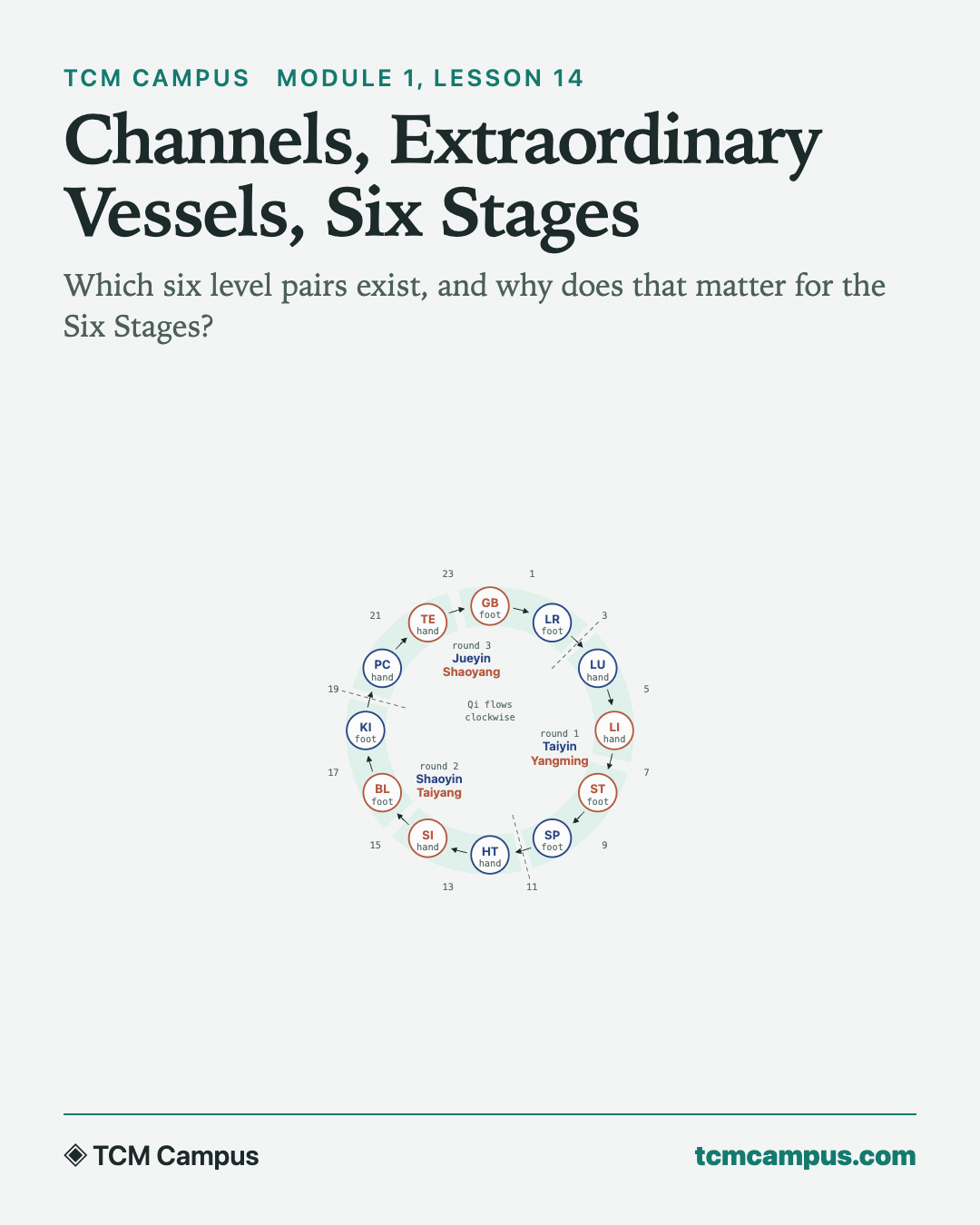
- The twelve in the order of the organ clock. LU, LI, ST, SP; HT, SI, BL, KI; PC, TE, GB, LR; then LU again. Clock: LU 3 to 5 a.m., two hours per channel, LR 1 to 3 a.m. (hours from general TCM knowledge). mnemonic: three rounds of four; each round starts in the chest with a Yin-hand channel (LU, HT, PC), then Yang-hand, Yang-foot, Yin-foot.
- Six levels, each hand plus foot. Taiyin LU and SP; Yangming LI and ST; Shaoyin HT and KI; Taiyang SI and BL; Jueyin PC and LR; Shaoyang TE and GB. mnemonic: each round is one level pair: Taiyin with Yangming, Shaoyin with Taiyang, Jueyin with Shaoyang.
- Partner versus namesake. Partner: next to each other in the flow, same limb (LU and LI). Namesake: same level name, hand and foot (LU and SP).
- Eight Extraordinary Vessels, four opening pairs. Du: SI-3 with BL-62 (Yang Qiao); Ren: LU-7 with KI-6 (Yin Qiao); Chong: SP-4 with PC-6 (Yin Wei); Dai: GB-41 with TE-5 (Yang Wei). Only Ren and Du have points of their own. mnemonic: each pair is an arm and a leg; the Yang pairs follow the level (Taiyang, Shaoyang), the Yin pairs do not.
- The Six Stages, from outside to inside. Taiyang, Yangming, Shaoyang, Taiyin, Shaoyin, Jueyin. mnemonic: Yang Greater, Bright, Lesser; Yin Greater, Lesser, Terminal; the three Yang mostly Excess, the three Yin mostly Deficiency.
- The Four Levels in Heat diseases. Wei, Qi, Ying, Xue. mnemonic: start with Wei, the guard on the outside; end in Xue, the Blood.
- The book's codes. HE (HT), KID (KI), P (PC), SJ (TE), LIV (LR), REN (CV), DU (GV); in English texts Du always means the Governing Vessel. mnemonic: Du is always the Vessel; SI-3 only opens the door to it.
The rest of this lesson is reference.
Three practice questions from this lesson
Which channel comes after the Spleen in the flow?
- HT (Heart)
- LU (Lungs)
- SI (Small Intestine)
Answer: HT (Heart). SP passes on to HT; the second round starts there. SI only follows after HT, LU starts the first round.
Which channel comes after LR?
- GB (Gall-Bladder)
- PC (Pericardium)
- LU (Lungs)
Answer: LU (Lungs). The circle is closed: after LR comes LU again. GB comes before LR, PC starts the third round.
Who is the Interior-Exterior partner of PC?
- LR
- TE
- HT
Answer: TE. PC and TE are partners. LR is the namesake: together they are Jueyin.
The rest of this lesson
In the course you get the step-by-step explanation, 19 case-based practice questions, 52 spaced-repetition flashcards, the pitfalls and the bridge to physiology with evidence grades. This lesson belongs to module 1: Foundations.