All lessons Module 5: Patterns Lesson 13
The pathogenic factors: six climates, from outside and from inside
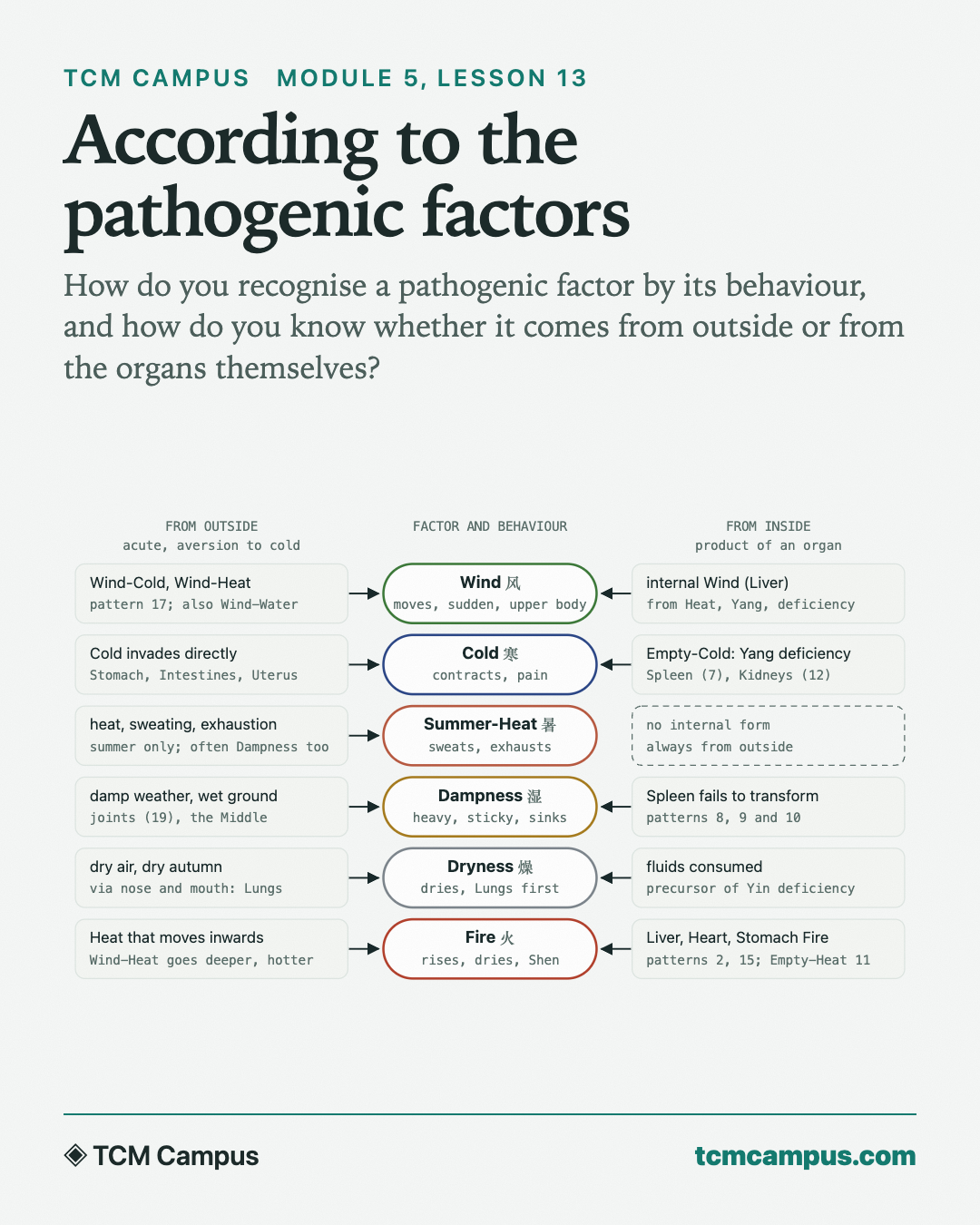
How do you recognise a pathogenic factor by its behaviour, and how do you know whether it comes from outside or from the organs themselves?
After this lesson you know, for each factor, its behaviour and its external and internal forms, with signs, tongue, pulse, principle and a formula as an anchor, and you see which core patterns from module 1 are in fact an internal factor. The characteristics are learning anchors, not validated criteria.
Know by heart
- Six factors, six behaviours. Wind moves, comes suddenly and affects the upper body; Cold contracts and causes pain; Summer-Heat comes only in summer, makes you sweat and exhausts; Dampness is heavy, sticky, sinks and lingers; Dryness dries, the Lungs first; Fire rises, dries, disturbs the Shen and causes bleeding. mnemonic: Wind wanders, Cold contracts, Dampness drags, Dryness cracks, Fire flares; Summer-Heat only shows up in the hot season.
- Outside or inside. External: acute, aversion to cold or wind, floating pulse; principle: expel. Internal: the product of an organ, with no exterior signs; principle: remove the factor and restore the organ. mnemonic: if the patient shivers and the pulse floats, the invader is still at the gate.
- Internal Wind, three sources. Extreme Heat (Ling Jiao Gou Teng Tang), Liver-Yang rising to Wind (Tian Ma Gou Teng Yin), Blood or Yin deficiency giving Empty-Wind (in Yin deficiency Da Ding Feng Zhu). Tremor, tics, dizziness, numbness; when severe, convulsions or a stroke; pulse wiry. Principle: extinguish Wind, do not expel it. mnemonic: Wind from Fire, Wind from Yang, Wind from emptiness.
- Cold: Full or Empty. Full: sudden, severe cramping pain, better for warmth, thick white coating, pulse tight; expel and warm. Empty: Yang deficiency, chronically feels the cold, pale and wet, pulse deep, weak, slow; warm and tonify Yang (Li Zhong Wan for the Spleen).
- Summer-Heat. External only, summer only: heat, heavy sweating, thirst, scanty dark urine, exhaustion; often with Dampness (heaviness, nausea, sticky coating). Tongue red; pulse rapid. Clear Summer-Heat and preserve Qi and fluids (Qing Shu Yi Qi Tang). Confused and hot is heatstroke: emergency services.
- Dampness and Dryness. Dampness: heaviness, sticky coating, pulse slippery or soggy; resolve and drain (Damp-Cold Ping Wei San, Damp-Heat San Ren Tang). Dryness: dry throat, nose, lips and skin, dry cough, dry tongue; moisten (warm Dryness Sang Xing Tang, cool Dryness Xing Su San). Dryness is the precursor of Yin deficiency.
- Heat versus Fire. Fire is hotter and drier, rises, disturbs the Shen, causes bleeding and ulcers; tongue red with a dry yellow coating, pulse rapid and full. Heat you clear, Fire you drain; Fire-Poison: Huang Lian Jie Du Tang. mnemonic: Heat is a warm room, Fire is a flame licking the ceiling.
The rest of this lesson is reference.
Three practice questions from this lesson
Case. Man, 34, road worker, during a heatwave. Since this afternoon: headache, red face, heavy sweating, great thirst, passes little dark urine, feels drained. Alert and fully responsive, 38.2 °C. Tongue red and dry. Pulse rapid.
- 2 Liver-Fire
- Wind-Heat
- Summer-Heat
Answer: Summer-Heat. Season, heavy sweating, thirst, scanty dark urine and exhaustion: Summer-Heat, which drives out Qi and fluids. No sore throat and no aversion to cold: not Wind-Heat. Liver-Fire is internal and has nothing to do with the season. He is alert: no heatstroke, but cool him, give fluids and keep an eye on him.
Case. Woman, 81, during a heatwave, on diuretics. Her daughter finds her drowsy and confused, skin hot and dry, 40.6 °C. What comes first?
- Summer-Heat: Qing Shu Yi Qi Tang
- Call emergency services and cool her
- Summer-Heat with Dampness: drain Dampness
Answer: Call emergency services and cool her. Confusion with a core temperature above 40 °C after heat exposure is heatstroke; the only specific treatment is rapid cooling (Bouchama 2022). A TCM label has no place here.
Case. Woman, 52. For months slight tremor of the hands, tingling, dry eyes and blurred vision, dry itchy skin. Tongue pale and thin. Pulse thin. Her doctor found a normal thyroid and no neurological disease.
- External Wind
- Liver-Yang rising to Wind
- Empty-Wind from Blood deficiency
Answer: Empty-Wind from Blood deficiency. Small movements with a pale, thin tongue and dry eyes: the Blood does not nourish the sinews, so Empty-Wind. No throbbing headache or high blood pressure: not Liver-Yang. Not acute, no exterior signs: not external.
The rest of this lesson
In the course you get the step-by-step explanation, 14 case-based practice questions, 25 spaced-repetition flashcards, the pitfalls and the bridge to physiology with evidence grades. This lesson belongs to module 5: Patterns.