All lessons Module 5: Patterns Lesson 18
Patterns according to the Eight Extraordinary Vessels
When do you think of an Extraordinary Vessel instead of an organ, and which picture belongs to which vessel?
After this lesson you can recognise, for each Extraordinary Vessel, the classical complaint from the Nan Jing and the textbook patterns; you read the uterine pictures of Ren and Chong together, you tell rebellious Qi of the Chong from a Liver or Heart pattern, and you know which pair of opening points belongs to which picture.
Know by heart
- When an Extraordinary Vessel. Complaints across several channels or on both sides; constitution and Essence; stages of life and the cycle; a picture that does not add up in organ language. mnemonic: broad, deep, cyclical.
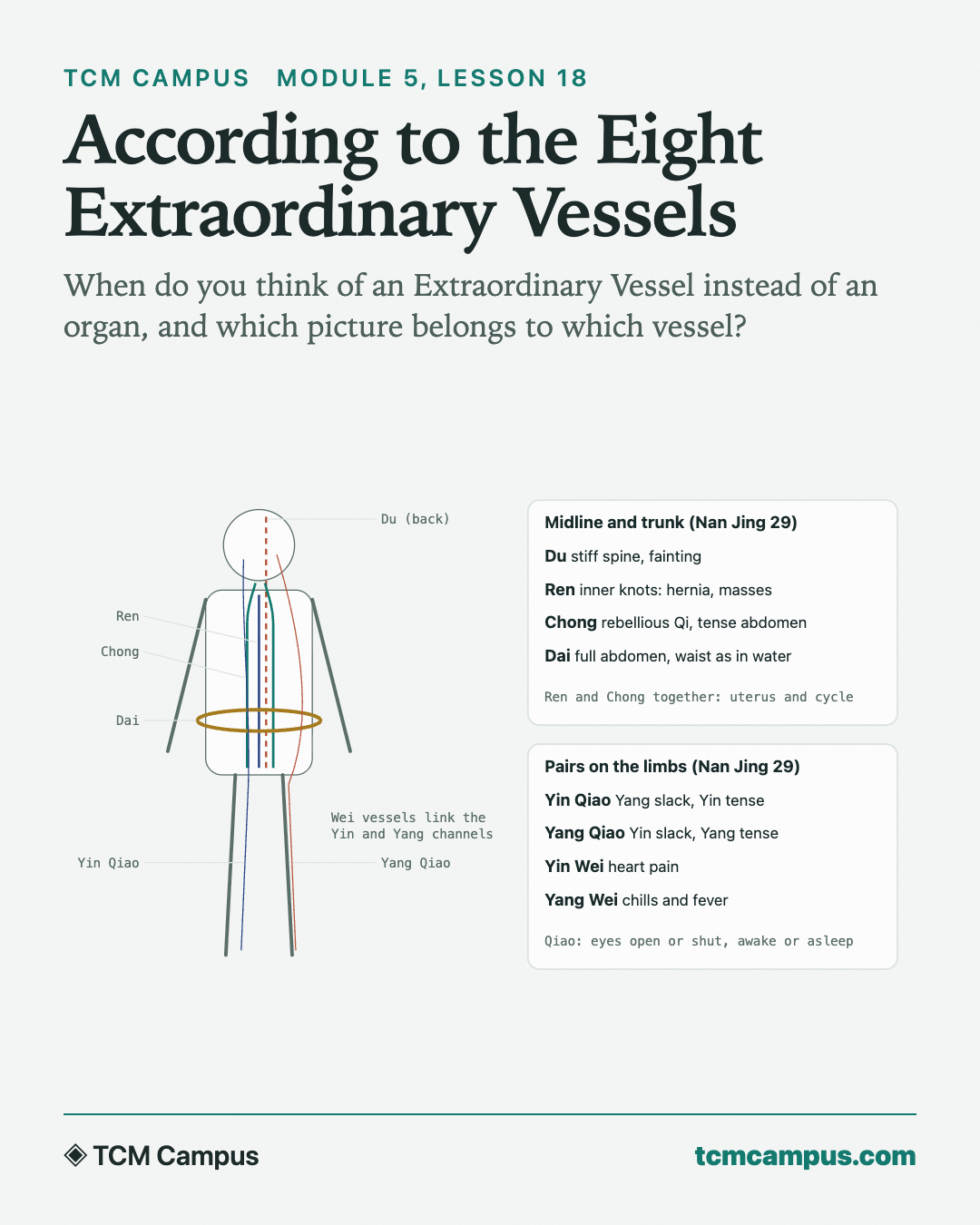
- Nan Jing 29, the four of the trunk. Du: stiff spine and fainting. Ren: inner knots, hernia in men, masses in women. Chong: rebellious Qi with tension in the abdomen. Dai: full abdomen, the waist as if you were sitting in water.
- Nan Jing 29, the four pairs. Yin Qiao: Yang slack, Yin tense. Yang Qiao: Yin slack, Yang tense. Yin Wei: heart pain. Yang Wei: chills and fever. mnemonic: Qiao is about tension; Wei about inside (heart) and outside (fever).
- Ren and Chong together, six pictures. Deficient; not firm; stasis; Cold; Heat in the Blood; Damp-Heat (textbook knowledge). mnemonic: too little, leaking, stuck, cold, hot, dirty.
- Opening pairs. SP-4 with PC-6 (Chong and Yin Wei); LU-7 with KI-6 (Ren and Yin Qiao); SI-3 with BL-62 (Du and Yang Qiao); GB-41 with TE-5 (Dai and Yang Wei).
- Qiao and sleep. Yang Qiao in excess: the eyes stay open, insomnia. Yin Qiao in excess: the eyes fall shut, sleepiness (textbook knowledge). mnemonic: Yang keeps the eyes open.
- Red flag. Convulsions or sudden loss of function; bleeding after the menopause, between periods or very heavy; a lump or swelling in the lower abdomen or groin; fever with lower abdominal pain: see a doctor first.
The rest of this lesson is reference.
Three practice questions from this lesson
Which complaint does Nan Jing 29 give for the Chong Mai?
- Stiff spine and fainting
- Rebellious Qi and tension in the abdomen
- Inner knots, hernia in men, masses in women
Answer: Rebellious Qi and tension in the abdomen. Nan Jing 29: a stiff spine and fainting belong to the Du; inner knots, hernia in men and masses in women to the Ren.
'The waist feels as if you were sitting in water.' Which vessel?
- Dai Mai
- Yin Qiao
- Ren Mai
Answer: Dai Mai. Nan Jing 29 on the Dai Mai: full abdomen, the waist slack as if you were sitting in water.
Nan Jing 29 on the Yang Qiao:
- Yin slack, Yang tense
- Yang slack, Yin tense
- Stiff spine
Answer: Yin slack, Yang tense. In the Yang Qiao the outside (Yang) is tense; in the Yin Qiao the reverse.
The rest of this lesson
In the course you get the step-by-step explanation, 15 case-based practice questions, 18 spaced-repetition flashcards, the pitfalls and the bridge to physiology with evidence grades. This lesson belongs to module 5: Patterns.